Ajax sits on the northern shore of Lake Ontario, and that lakeside location defines everything about our ground engineering. The water table here sits unusually high, often just a meter and a half below the surface, while large portions of the town rest on loose deltaic sands deposited by the ancient glacial Lake Iroquois. When you propose a commercial building or a mid-rise residential block on those soils, conventional footings become a gamble. Vibrocompaction design changes that equation completely. The process densifies the granular matrix in place, reducing the void ratio and cutting settlement risk before concrete ever touches the ground. Over the years we have seen how Ajax winters, with their freeze-thaw cycles that can heave untreated fills, make a properly compacted base not just a performance advantage but a long-term insurance policy. For deeper profiling we often pair the design with CPT testing to map relative density versus depth, and in areas where the sand transitions to silty zones we evaluate liquefaction potential under the seismic demands of the NBCC.
Densifying the ground before construction eliminates the settlement variable, and in Ajax's high-water-table sands, that means the difference between a straightforward project and a decade of maintenance.
Process and scope
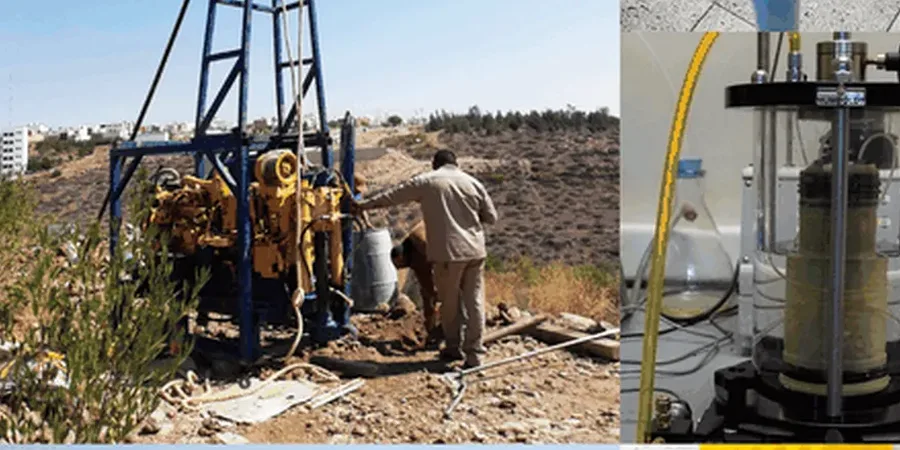
Local ground factors
The rig we mobilize for Ajax jobs is a hydraulically driven bottom-feed vibroflot suspended from a crawler crane, usually in the 130 to 180 kilowatt range, because the local sand demands enough energy to overcome the capillary cohesion near the water table. The probe oscillates horizontally while water jets at the tip fluidize the sand momentarily, allowing the particles to rearrange into a denser packing. In this part of Durham Region, the biggest operational risk is not the sand itself but the occasional buried organic layer. Pre-settlement swamps left behind pockets of peat that can collapse under vibration without warning. We catch those by running a few pilot test pits or CPT soundings ahead of the rig, so the grid design accounts for soft lenses before the main compaction campaign starts. Another factor is proximity: Ajax has dense residential subdivisions, and the vibration amplitude has to be monitored with geophones to stay within municipal limits and avoid nuisance claims.
Reference standards
NBCC 2020 (National Building Code of Canada), ASTM D6066-18 (Standard Practice for Determining the Normalized Penetration Resistance of Sands), ASTM D5778-20 (Standard Test Method for Performing Electronic Friction Cone and Piezocone Penetration Testing), CSA A23.3-19 (Design of Concrete Structures)
Other technical services
Pre-Treatment Site Characterization and Design Modeling
We collect CPT and grain-size data across the footprint, map the depth to the water table and any soft inclusions, and build a finite-element settlement model. The output is a grid layout with probe spacing, amperage targets, and hold times per stage, all calibrated to the Ajax soil profile and the NBCC site-class objective for your structure.
Post-Compaction Verification and Compliance Reporting
After the rig finishes the compaction passes, we execute a network of verification CPT soundings at the centroid of the treatment cells. The acceptance criterion is a measured tip resistance that corresponds to at least 70 percent relative density, documented in a stamped report that satisfies both the building official and your geotechnical engineer of record.
Typical parameters
Questions and answers
How much does vibrocompaction design cost for a typical Ajax building lot?
Our vibrocompaction design packages in Ajax usually fall between CA$1.730 and CA$7.490, depending on the treated area, depth requirement, and the number of pre- and post-treatment CPT soundings needed. A small commercial pad of around 500 square meters with straightforward sand conditions tends toward the lower end, while a larger industrial footprint with variable fill and deeper treatment pushes toward the upper range.
At what depth does vibrocompaction stop being effective in Ajax soils?
For the uniform sands common across Ajax, vibrocompaction remains effective down to about 15 meters, though most of our local designs target 8 to 10 meters because that reaches below the zone of seasonal moisture fluctuation and provides a competent bearing stratum for shallow foundations. Beyond that depth, the overburden pressure reduces the compaction efficiency and stone columns often become a more practical solution.
Can vibrocompaction be used right next to existing houses in Ajax subdivisions?
Yes, but with careful vibration monitoring. The Durham Region by-laws and standard engineering practice require peak particle velocity to stay below 5 mm/s at the nearest off-site foundation. We install triaxial geophones at the property line and adjust the vibrator frequency and hold time in real time to stay within that limit without sacrificing compaction density.
What happens if the sand contains more silt than expected?
When the fines content exceeds about 12 to 15 percent, the pore pressure generated by the vibrator cannot dissipate fast enough and the compaction efficiency drops sharply. In those cases we modify the design, either by pre-drilling to create drainage paths, introducing a stone column element at selected grid points, or switching the ground improvement strategy to a combination of vibro-replacement and surcharge.