Ajax sits at roughly 90 meters above Lake Ontario, but what matters for any foundation here is what lies in the first 10 to 15 meters below grade. The town expanded rapidly through the 1990s and 2000s, pushing residential subdivisions and commercial plazas onto the complex glacial stratigraphy left by the retreat of the Laurentide Ice Sheet. In our lab, the triaxial test has become the decisive tool when a client needs more than index properties—when the question is how a clayey silt till will behave under the sustained load of a four-story building or a stormwater management facility. We run consolidated-undrained triaxial with pore pressure measurement as the default for these saturated deposits, because effective stress parameters are what a geotechnical engineer actually needs for a defensible bearing capacity calculation under the Ontario Building Code. Complementing field exploration like SPT drilling with advanced laboratory strength testing closes the gap between a standard site investigation and a design you can stand behind when the Town of Ajax reviews the submission.
A Shelby tube sample from Ajax glaciolacustrine clay may look intact, but consolidated-undrained triaxial testing often reveals a friction angle below 26 degrees—a parameter that governs the entire foundation design.
Process and scope
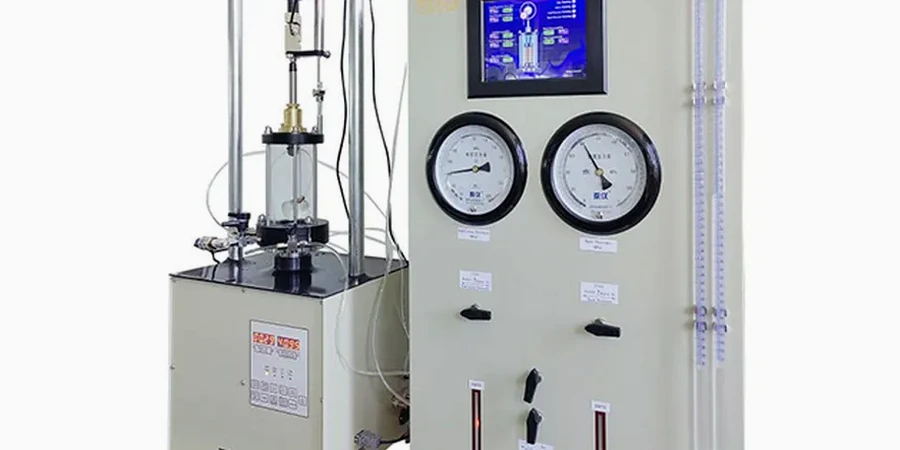
Local ground factors
What we see repeatedly in Ajax is that developers rely on standard penetration test N-values from the overconsolidated crust and assume the deeper glaciolacustrine unit will perform similarly—until a triaxial test proves otherwise. The crust, typically 3 to 5 meters of weathered till, gives N-values above 15 and looks competent, but the underlying silty clay can show normalized undrained shear strength ratios below 0.25, which puts it squarely in the soft to firm category. If you skip the triaxial stage and extrapolate bearing capacity from SPT correlations alone, you risk underestimating settlement by a factor of two or more in the softer lenses. The cost of a triaxial program—three specimens from a single tube—is negligible compared to the cost of underpinning a settled structure or, worse, litigating a foundation failure. We run these tests because a single undisturbed sample sheared under the correct confining stress tells you more about real soil behavior than a hundred hammer blows ever will.
Reference standards
ASTM D4767-11: Standard Test Method for Consolidated Undrained Triaxial Compression Test for Cohesive Soils, ASTM D2850-15: Standard Test Method for Unconsolidated-Undrained Triaxial Compression Test on Cohesive Soils, Ontario Building Code (OBC) Division B, Part 4: Geotechnical requirements referencing CSA A23.3 and NBCC 2015 foundation provisions
Other technical services
Consolidated-Undrained (CU) Triaxial with Pore Pressure
Three specimens from a single Shelby tube are consolidated to estimated in-situ effective stresses and sheared at a controlled strain rate while recording excess pore pressure. We deliver the Mohr-Coulomb failure envelope in effective stress terms, the A-parameter at failure, and stress-strain curves for input into finite element or limit equilibrium models. This is the standard test for the saturated silts and clays found across the Duffins Creek watershed.
Unconsolidated-Undrained (UU) Triaxial for Emergency or Fast-Track Projects
When a contractor hits unexpected soft ground during excavation in Ajax and needs a rapid undrained shear strength value to verify temporary slope stability, we run UU triaxial on trimmed specimens without saturation or consolidation. Results are available within 48 hours and provide a conservative total-stress strength envelope for immediate decision-making on shoring adjustments.
Typical parameters
Questions and answers
What is the typical cost range for a triaxial test program in Ajax?
For a standard consolidated-undrained triaxial set with three specimens from a single Shelby tube, including saturation, consolidation, shear, and a full report with Mohr-Coulomb parameters, the cost typically falls between CA$2,250 and CA$4,220 depending on soil type, required confining pressures, and whether additional index testing on the same sample is needed.
Which triaxial test type is most appropriate for the clayey silt till common in Ajax?
For the glacially overconsolidated till and underlying glaciolacustrine deposits, we recommend consolidated-undrained testing with pore pressure measurement per ASTM D4767. This gives effective stress parameters that account for the soil's stress history and saturation state, which SPT correlations cannot capture reliably in these transitional soils.
How long does it take to receive triaxial test results after sampling?
A complete CU triaxial program on fine-grained soils typically requires 10 to 14 working days. The consolidation phase alone can take 24 to 48 hours per specimen depending on hydraulic conductivity, and we run all three specimens sequentially on the same frame to maintain consistency. UU triaxial for urgent projects can be reported within 48 hours.
Do you provide the stress-strain curves and pore pressure plots with the report?
Yes, every triaxial report includes the deviator stress versus axial strain curves for all three specimens, excess pore pressure versus strain plots, effective stress paths on a p'-q diagram, and the interpreted Mohr-Coulomb failure envelope. We also supply a summary table with c', φ', and the Skempton pore pressure parameter at failure for direct use in geotechnical design software.