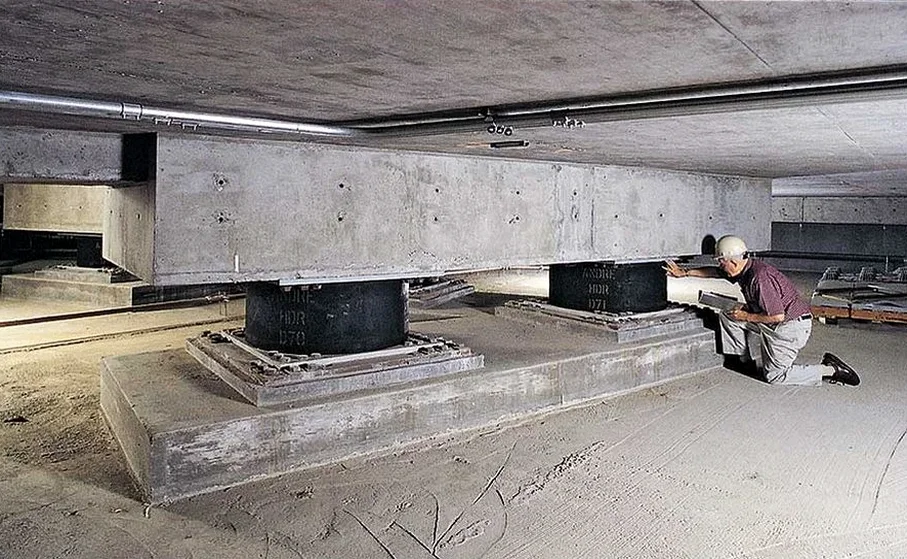
The National Building Code of Canada (NBCC 2020) assigns Ajax a moderate to elevated seismic hazard profile, a reality shaped by the deep glacial and post-glacial sediments that blanket the Lake Ontario shoreline. The town overlies thick sequences of glaciolacustrine silty clays and loose deltaic sands deposited during the retreat of Lake Iroquois, materials that amplify long-period ground motion and complicate conventional fixed-base design. For healthcare facilities, emergency response centres, and mid-rise commercial structures where operational continuity after a seismic event is non-negotiable, base isolation is not a speculative upgrade but a rational, code-recognized strategy to decouple the superstructure from damaging ground movement. The design process begins with a site-specific seismic hazard assessment per NBCC Division B, incorporating shear-wave velocity profiling from the MASW survey to establish Site Class and confirm the spectral acceleration values that drive isolator selection. Isolator prototypes — typically lead-rubber bearings or high-damping natural rubber units — are then modelled in nonlinear time-history analysis using ground motion records scaled to the Ajax uniform hazard spectrum, ensuring the isolation system meets the displacement demands of the 2,475-year return period event without exceeding the clearance constraints of the moat wall.
Base isolation in Ajax targets a 60–80 percent reduction in floor spectral accelerations compared to a fixed-base design, preserving both structural integrity and sensitive equipment during the design-level event.
Process and scope
Local ground factors
On Ajax sites within the Duffins Creek watershed and the Carruthers Creek floodplain, the combination of soft normally consolidated silty clay extending 15 to 25 metres below grade and a water table that sits within 1.5 metres of the surface creates a risk profile that inexperienced designers routinely underestimate. Excavation for the isolation basement and moat wall triggers rapid groundwater inflow that can soften the bearing stratum beneath isolator pedestals, reducing stiffness and introducing differential settlement between isolation units. A more insidious problem emerges when the moat wall drainage system is undersized: hydrostatic pressure buildup during spring thaw saturates the isolation plane, corroding connection plates and degrading the thermal jacket of the bearings. The design team addresses this with a dual approach: a perimeter wellpoint dewatering system maintained during construction, and a permanent drainage mat on the exterior face of the moat wall connected to a duplex sump pump arrangement. For the Ajax Health Centre expansion and similar essential-service buildings, the isolation system is specified with a moat cover capable of supporting fire truck access loads, ensuring that the seismic gap does not become an operational liability for emergency vehicle circulation in the hours after a major event.
Reference standards
NBCC 2020 — Division B, Part 4 (Structural Design), CSA A23.3-19 — Design of Concrete Structures, ASTM D4014-23 — Standard Specification for Plain and Steel-Laminated Elastomeric Bearings for Bridges, CSA S832-14 (R2019) — Seismic Risk Reduction of Operational and Functional Components in Buildings, NRC-CNRC Guidelines for Seismic Design of Base-Isolated Structures (2020 edition)
Other technical services
Site-Specific Seismic Hazard Analysis
Development of uniform hazard spectra (UHS) and conditional mean spectra (CMS) for the Ajax site, incorporating probabilistic and deterministic NBCC 2020 hazard values. Includes Site Class determination via shear-wave velocity measurement and time-history selection from the PEER NGA-West2 database matched to local spectral shape.
Nonlinear Isolator Modelling and Time-History Analysis
Full 3D structural model of the isolated superstructure in ETABS or PERFORM-3D, with bilinear or Bouc-Wen hysteresis for lead-rubber bearings. Seven-pair ground motion suite scaled per ASCE 7-16 Chapter 17, with response extraction for inter-storey drift, isolator displacement, and floor acceleration spectra.
Isolator Prototype Testing and Quality Assurance
Witnessing and interpretation of full-scale bearing tests at the manufacturer's facility per ASTM D4014. Verification of vertical stiffness, cyclic shear properties, and damping ratio at design displacement. Review of elastomer compound certification and steel shim tensile test reports.
Moat Wall and Isolation Plane Construction Support
Shop drawing review for pedestal anchor bolt layout, oversized hole detailing, and moat cover assemblies. On-site inspection during bearing installation and alignment, including grout pad preparation and torque verification of connection bolts per CSA S16-19.
Typical parameters
Questions and answers
What is the typical cost range for a base isolation seismic design package for a mid-rise building in Ajax?
For a 4- to 8-storey commercial or institutional building in Ajax, the complete design package — covering site-specific hazard analysis, nonlinear modelling, isolator specification, prototype test oversight, and construction-phase support — falls in the range of CA$5,140 to CA$10,530. The final figure depends on the number of isolators, the complexity of the moat wall geometry, and whether the project requires a peer review panel under NBCC Part 4.
How does the Ajax lakebed soil profile affect base isolation design compared to rock sites in Ontario?
The deep glaciolacustrine clay deposits underlying Ajax produce a Site Class D or E profile that amplifies spectral accelerations at periods between 1.0 and 2.5 seconds — precisely the range where an isolated structure's fundamental mode sits. This means the isolation system must handle larger spectral displacement demands than a comparable building on the limestone bedrock of the Oak Ridges Moraine. The design compensates with larger-diameter bearings and a moat wall setback verified through nonlinear site response analysis using DEEPSOIL or equivalent software.
Can an existing Ajax building be retrofitted with base isolation, or is this only viable for new construction?
Retrofit isolation is technically feasible but surgically demanding: it requires temporarily supporting the superstructure on jacking columns while the existing columns are severed and bearings are inserted at the new isolation plane. For Ajax buildings with shallow spread footings in soft clay, the retrofit sequence must include underpinning of the foundation system to create the rigid basement diaphragm needed below the isolation plane. This is significantly more expensive than new-build isolation and is generally reserved for heritage structures or hospitals where demolition is not an option.
What maintenance does a base isolation system require over the building's service life in Ajax?
The bearings themselves are maintenance-free for their 50-year design life, but the moat wall assembly requires periodic attention. In Ajax, where freeze-thaw cycles can crack moat cover sealant and spring snowmelt can overwhelm drainage systems, we specify an annual inspection of the moat perimeter: check drainage sump function, verify cover plate anchor bolts for corrosion, and inspect elastomeric thermal wraps for moisture ingress. Every five years, a detailed visual inspection of the bearings is recommended, with ultrasonic bolt tension verification per CSA S16-19.