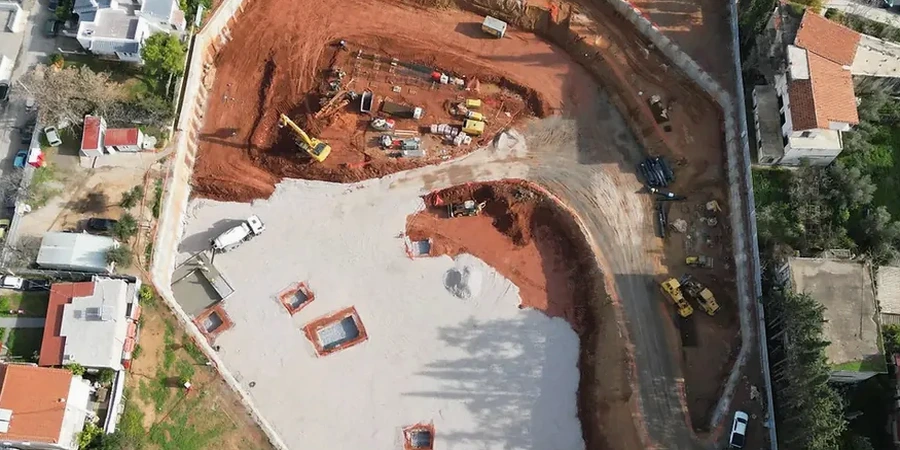
The biggest mistake we see in Ajax is treating a 6-meter cut like a shallow trench. The glacial soils here don't give much warning before a base failure. You get a boiler failure in the bottom, the sheet piles kick in, and suddenly you're dealing with a utility break and a sidewalk settlement. Deep excavation design isn't just about picking a soldier pile spacing out of a table — it requires modeling the staged cuts, checking basal heave against the till's undrained strength, and accounting for the groundwater that sits barely 3 meters down across much of Durham Region. Our lab runs the triaxial and consolidation tests that feed those models, so the shoring contractor has real numbers, not textbook assumptions. We also pair the design with slope stability analysis when the excavation backs up against an existing embankment or a ravine slope, which happens often in the creek-crossed neighborhoods of Ajax.
Base stability in Ajax is controlled by the silt lenses in the till — miss them in the borehole log and you miss the failure mechanism.
Process and scope
Local ground factors
Ajax has pushed over 130,000 residents into a fairly compact urban footprint, and much of the new construction is infill — deep excavations sandwiched between occupied houses or active roadways. The risk isn't theoretical. A 2019 excavation on Harwood Avenue lost a section of shoring after a rainstorm saturated the silt seam behind the wall, and the resulting settlement cracked foundations three houses down. That's the cost of a design that didn't account for perched water in the till. Our approach bakes in a groundwater contingency from day one: we specify the dewatering trigger levels, the backup pump capacity, and the monitoring frequency that the Ontario Professional Engineers guideline (PEO) expects for deep excavations. We also run a liquefaction check using the liquefaction assessment methodology from Youd and Idriss (2001) when the bottom of the excavation sits in loose saturated sand — a scenario that shows up in the southern parts of Ajax near the lake. The design report includes a construction sequence table that the contractor must follow; if they skip a strut level, the wall movements will exceed the predictions, and the monitoring data will flag it within 24 hours.
Video overview
Reference standards
Ontario Building Code 2020 (O. Reg. 332/12), CSA A23.3:19 Design of Concrete Structures, NBCC 2020 seismic provisions, ASTM D7181 (consolidated drained triaxial for till), FHWA Geotechnical Engineering Circular No. 4 (ground anchors)
Other technical services
Shoring wall design and analysis
We produce detailed shoring designs for soldier pile and lagging, sheet pile, secant pile, or diaphragm walls. The analysis uses limit equilibrium and numerical methods, with output drawings showing pile sections, embedment depths, waler elevations, and connection details. All designs include a constructability review specific to Ajax's till and boulder conditions.
Dewatering and groundwater control plan
Using the permeability data from our in-situ tests and lab falling-head measurements, we design the dewatering system — well points, deep wells, or sump pumping — with radius of influence calculations. The plan includes discharge rates, settlement predictions from pore pressure drop, and a water management permit support package for TRCA or CLOCA review.
Construction-phase monitoring and peer review
We install and read inclinometers, piezometers, and survey points through the excavation sequence. Weekly reports compare measured movements to the design predictions, with trigger-level alerts if deflections approach the pre-set thresholds. We also provide independent peer review of contractor-submitted shoring shop drawings for municipal permit applications.
Typical parameters
Questions and answers
What does a deep excavation design package cost for a typical Ajax project?
For a standard mid-rise excavation in Ajax — say 6 to 9 meters deep with soldier piles and tiebacks — the design fee ranges from CA$2,830 to CA$10,540 depending on the number of shoring sections, the complexity of the groundwater model, and whether monitoring services are included. A multi-level anchored system with adjacent heritage buildings on the property line will sit at the upper end of that range.
How do you handle boulders in the Halton Till during shoring design?
We log boulder frequency during the test pit and borehole investigation phase. If the count exceeds one boulder per 2 meters of advance, we flag it in the constructability section of the design report. The shoring design may specify pre-drilling through boulder zones, using heavier H-pile sections to handle refusal impacts, or switching to a secant pile wall if the boulder density makes soldier pile installation impractical for the Ajax till conditions.
What's the typical timeline from investigation to Issued for Construction drawings?
For a deep excavation in Ajax, the field investigation takes one to two weeks. Laboratory triaxial and consolidation testing on the till samples runs three to four weeks. The analysis and drafting phase is another three to four weeks. So from notice to proceed to signed IFC drawings, budget eight to ten weeks — longer if TRCA review for dewatering is triggered.
Do you provide the excavation monitoring or just the design?
We offer both. The design report includes the monitoring plan with instrument locations, reading frequencies, and trigger values. We can then execute the monitoring contract — installing the inclinometers and piezometers before excavation starts, taking baseline readings, and reporting weekly through the cut sequence. Having the designer also doing the monitoring closes the loop fast when field conditions deviate from the geotechnical baseline report.