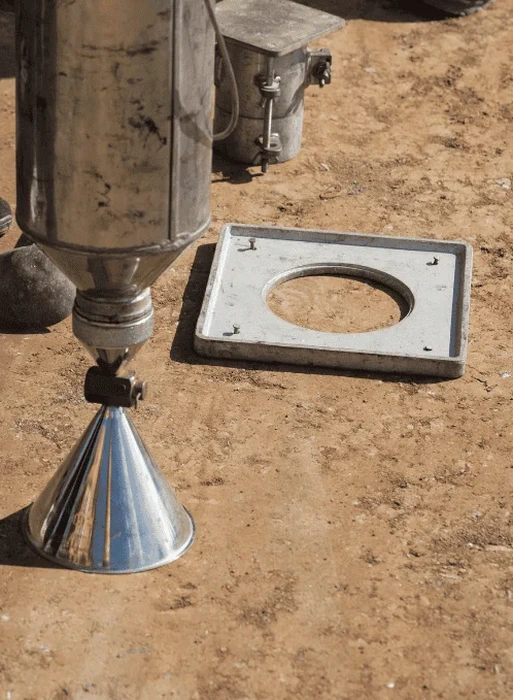
Ajax sits just above Lake Ontario on glacial till and shoreline deposits—material that varies from compact silty sand to loose, wet fill. With over 130,000 people and major residential subdivisions expanding north of Highway 401, getting compaction right on the first lift saves money and prevents rework. The sand cone test remains the most practical way to verify field density when nuclear gauges aren’t an option or a contractor needs a straightforward, defensible number. We run these tests daily on utility trenches, parking lot subgrades, and structural backfill behind retaining walls. The method follows ASTM D1556, and our lab runs companion Proctor tests to establish the reference maximum dry density before field work begins.
A sand cone test takes 20 minutes in the field but saves weeks of dispute over compaction compliance on a single utility trench.
Process and scope
Local ground factors
You can lay the same trench backfill on two different Ajax streets and get two very different outcomes. South Ajax, near the lake, deals with high groundwater and sands that pump water into a trench bottom if you don’t dewater properly—compaction drops fast when moisture goes above optimum. Up in the newer subdivisions around Audley North, the Halton Till is stiff but chunky; it takes a jumping jack or padfoot roller to break down the clods, and if you skip the sand cone check on the first lift, you won’t catch a 10% density shortfall until the paving crew is already on site. That kind of miss turns a two-day repair into a change order and a delay claim. The test isn’t just QA paperwork—it’s the cheapest insurance a builder has against settlement under sidewalks, driveways, and foundation backfill. We’ve seen poorly compacted storm sewer backfill in Ajax fail within three freeze-thaw cycles, opening up depressions that pond water and trigger municipal reinspection fees.
Reference standards
ASTM D1556 — Standard Test Method for Density of Soil in Place by the Sand-Cone Method, OPSS 501 — Compacting (Ontario Provincial Standard Specification), ASTM D698 / D1557 — Proctor Compaction Tests (laboratory reference), ASTM D2216 — Laboratory Determination of Water (Moisture) Content
Other technical services
Sand Cone Field Density Testing
On-site density determination per ASTM D1556 for backfill, subgrade, and trench reinstatement. Includes moisture sample, percent compaction calculation, and a stamped field report within 24 hours.
Laboratory Proctor Compaction Curves
Standard and modified Proctor tests (ASTM D698 / D1557) run on project-specific soil sampled from the Ajax site. We supply the maximum dry density and optimum moisture content that the field crew benchmarks against.
Compaction Inspection & QA/QC Reporting
Full-time or part-time compaction inspection for earthworks and utility contracts in Ajax. We coordinate lift thickness checks, sand cone frequency per OPSS 501, and daily reporting to the consultant and owner.
Typical parameters
Questions and answers
How much does a sand cone density test cost in Ajax?
For sites in Ajax and the broader Durham Region, field density testing using the sand cone method typically runs between CA$140 and CA$210 per test. The exact price depends on the number of tests per day, travel distance, and whether laboratory Proctor curves need to be developed. A full-day rate with a technician on site usually offers better value when you have multiple lifts or trenches to verify.
How many sand cone tests do I need per lift on an Ajax subdivision job?
Under OPSS 501, the minimum frequency is generally one test per 300 square metres of compacted area per lift, or one test per 20 linear metres of trench per lift, whichever governs. On Ajax sites with variable Halton Till, most geotechnical reports tighten that to one test per 150 square metres to catch density variations early.
Can the sand cone test be used when the ground is wet or frozen in Ajax?
Frozen ground is a no-go—ASTM D1556 requires the test hole to be excavated in unfrozen soil, and the calibration sand won't flow properly through ice lenses. Wet conditions are workable as long as the soil isn't pumping water into the hole; we oven-dry the moisture sample to get a true dry density. During Ajax's spring thaw, we typically schedule sand cone work for mid-morning after surface drainage has been managed.
How does the sand cone method compare to a nuclear density gauge in Ajax soils?
Both methods can yield reliable results, but the sand cone gives a direct volume measurement that doesn't need calibration for the specific soil chemistry—important in Ajax's glacial tills where variable iron and carbonate content can throw off a nuclear gauge. The trade-off is time: a sand cone test takes about 20 minutes versus 5 minutes for a nuclear gauge. On small trench jobs or areas with limited access, the sand cone is often the more practical choice.