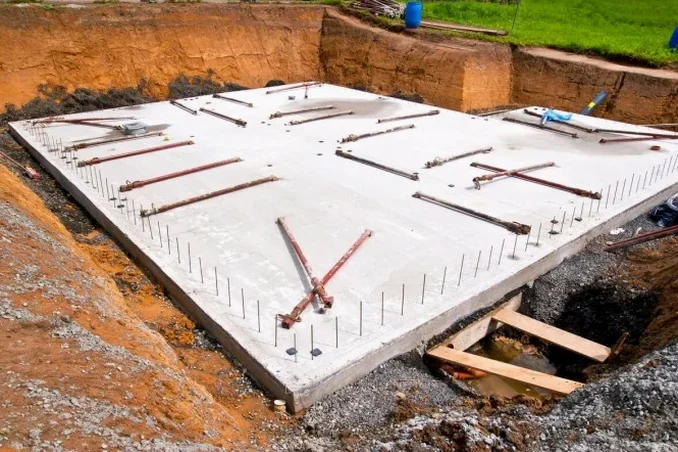
Raft foundation design in Ajax requires a clear understanding of the local stratigraphy. The Ontario Building Code, through NBCC 2020 and CSA A23.3, sets strict parameters for bearing capacity and settlement on the heterogeneous soils found south of the Oak Ridges Moraine. Surface geology here shifts dramatically within short distances: dense glacial till transitions into softer glaciolacustrine clays near the waterfront, a condition that makes uniform shallow footings unreliable. A rigid mat foundation bridges these variations, distributing structural loads across a wider footprint and reducing differential movement. For sites with questionable near-surface stability, we integrate findings from deep excavation monitoring to calibrate settlement predictions against real soil behavior.
In Ajax, the transition from stiff Halton Till to softer near-shore clays demands a mat foundation design that anticipates non-linear settlement profiles.
Process and scope
Local ground factors
Southern Ajax sits on a geological boundary where the hard till plain gives way to the softer sediments of the former glacial lake floor. This juxtaposition creates a risk scenario where a building founded partly on dense till and partly on compressible clay can experience differential settlement severe enough to crack superstructure walls. The freeze-thaw cycles typical of a Durham Region winter further complicate the soil-structure interaction. Frost penetration in saturated silts generates uplift forces at the slab perimeter, which a standard raft design must resist through integrated edge beams. When the bearing stratum is too erratic, we evaluate ground improvement before finalizing the mat geometry, often reviewing data from stone columns as a practical method to homogenize the soil mass beneath the footprint and limit total settlement.
Reference standards
NBCC 2020 (National Building Code of Canada), CSA A23.3-19 (Design of Concrete Structures), ASTM D1195 / D1196 (Repetitive Static Plate Load Tests)
Other technical services
Geotechnical Investigation for Mat Design
SPT borings and selective sampling to establish the stratigraphic profile across the building footprint. We determine the undrained shear strength of the clay and the relative density of the till, providing the parameters needed for bearing capacity and settlement analysis.
Settlement Analysis and Concrete Design
Finite element modeling of the soil-raft interaction to predict total and differential settlement under service loads. We produce structural drawings for the mat thickness, reinforcement layout, and edge beam details compliant with CSA A23.3.
Construction Phase Inspections
Subgrade verification prior to mud slab placement. We confirm the bearing surface is free of disturbed soil and standing water, and that the actual ground conditions match the design assumptions, documenting the inspection for the municipal building permit close-out.
Typical parameters
Questions and answers
When is a raft foundation more suitable than strip footings in Ajax?
A raft foundation is indicated when the allowable bearing capacity is low (below 150 kPa) or when the soil profile varies significantly across the building area. In Ajax, sites east of Westney Road often encounter pockets of organic silt where strip footings would experience unacceptable differential settlement. The mat bridges these soft zones.
What is the typical cost range for raft foundation design in Ajax?
Engineering fees for the geotechnical investigation and structural design of a raft foundation in Ajax typically range from CA$1,410 to CA$6,290, depending on the footprint area, number of boreholes required, and the complexity of the structural analysis. This covers the site investigation, laboratory testing, and the stamped design package.
How does the water table in Ajax affect the raft foundation construction?
A high water table, common near the Lake Ontario shoreline, requires dewatering during excavation to keep the subgrade dry. The raft design includes a capillary break and often a waterproofing membrane. We also verify that the buoyancy forces under saturated conditions do not exceed the structural dead load of the completed building.
Does the raft design need to account for seismic forces per NBCC 2020?
Yes. We classify the site per NBCC 2020 Table 4.1.8.4.A and apply the spectral acceleration values for Ajax. The rigid mat foundation helps reduce torsional effects during a seismic event, but the reinforcement detailing must accommodate the induced base shear transfer between the superstructure and the ground.