A contractor off Bayly Street called us last spring. Three lifts of fill had just been placed and the nuclear gauge readings were all over the map. The problem wasn’t the crew. The problem was a generic Proctor curve that didn’t match the silty sand coming out of a borrow pit near Duffins Creek. Ajax sits on glacial till and near-surface lacustrine deposits left by the old Lake Iroquois shoreline. That geology doesn’t forgive guesswork. We ran a Modified Proctor on the actual material and gave them a target density that made sense for the soil they were compacting. When earthworks move fast, having a lab that knows local ground conditions saves rework. We also pair this with sand cone density testing for field verification or grain size analysis when borrow sources change mid-project.
A Proctor test on borrowed fill that doesn’t match site geology is worse than no test at all. The curve has to belong to the soil under the roller.
Process and scope
Local ground factors
The Rouge River watershed and the Iroquois shoreline plain left Ajax with soils that swing from dense basal till to soft, wet silts in a matter of meters. Fill placed on the wet side of optimum in these silts traps pore pressure. It looks solid during compaction and fails a re-test two weeks later after the water redistributes. We’ve pulled cores from compacted pads near the 401 extension where the top six inches met spec and everything below was 5% under. That’s what happens when the Proctor curve was developed from a dried-out lab sample that doesn’t represent the in-situ moisture condition. Our lab keeps the sample at field moisture until the test starts. If the material is borderline for frost susceptibility we flag it. Ajax gets freeze-thaw cycles that punish poorly compacted subgrade. You won’t see the damage until spring. The Proctor is the cheapest insurance against that call-back.
Reference standards
ASTM D698-12(2021) – Standard Test Methods for Laboratory Compaction Characteristics of Soil Using Standard Effort, ASTM D1557-12(2021) – Standard Test Methods for Laboratory Compaction Characteristics of Soil Using Modified Effort, CSA A3000 – Cementitious Materials Compendium (calibration reference for compaction lab equipment), MTO LS-706 – Method of Test for Moisture-Density Relationship of Soils (Ontario provincial standard)
Other technical services
Standard and Modified Proctor Curves
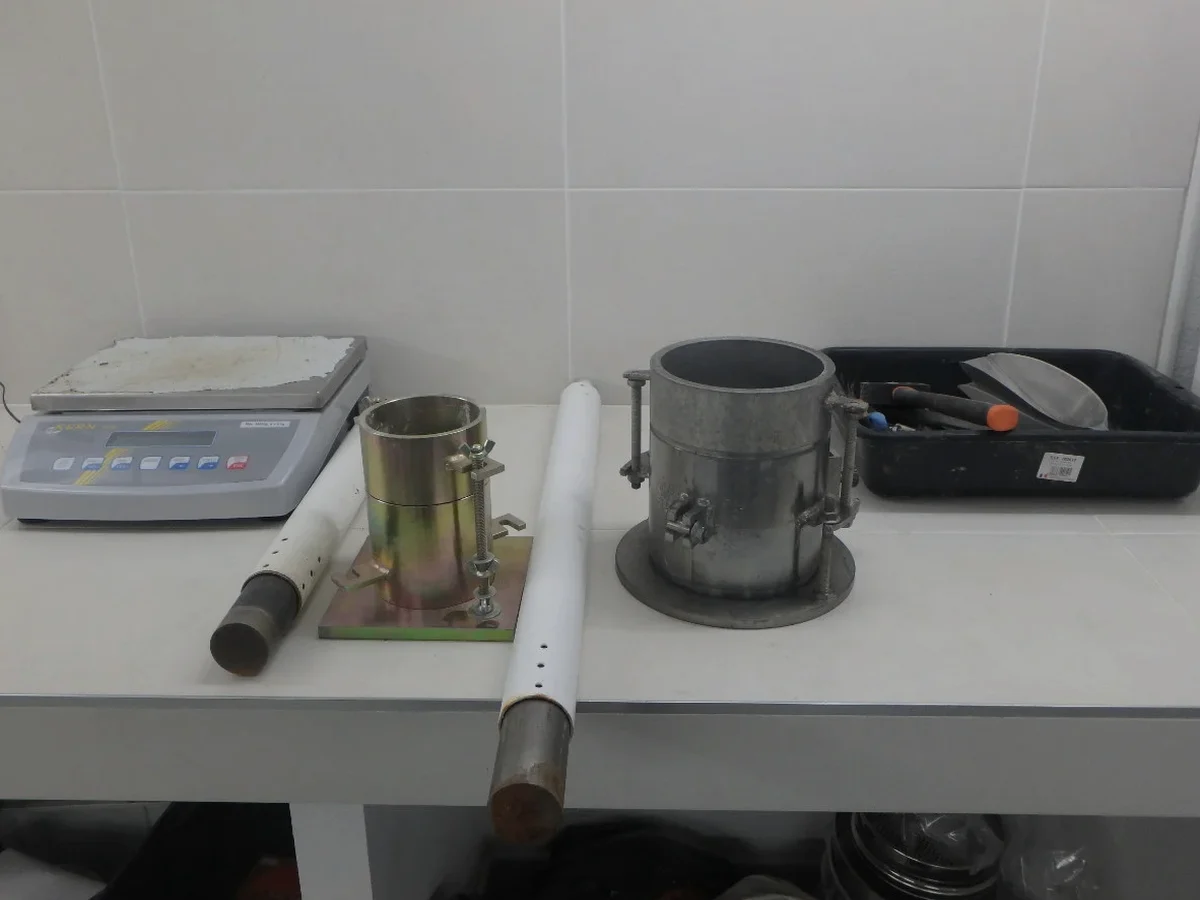
Full multi-point curves for engineered fill specifications in Ajax subdivisions and commercial pads. We run both 4-inch and 6-inch molds depending on maximum particle size.
Field Compaction Control Support
One-point Proctor checks, rapid moisture content determination, and nuclear gauge correlation to keep earthworks moving without waiting on full lab cycles.
Typical parameters
Questions and answers
What’s the difference between Standard and Modified Proctor in practical terms for an Ajax site?
Standard Proctor simulates compaction from light equipment or early-era rollers. Modified Proctor uses 4.5 times the compactive energy and better represents modern vibratory rollers and heavy sheepsfoot compactors. Most engineered fill specs in Ajax subdivisions call for Modified Proctor at 95% or 98% of maximum dry density. If the spec doesn’t state which one, check the geotechnical report. Guessing wrong means either over-compacting and wasting fuel or under-compacting and failing the density test.
How much does a Proctor test cost in Ajax?
A Standard or Modified Proctor test typically runs between CA$160 and CA$260 depending on whether it’s a single-point or full multi-point curve. Rush turnaround adds a small surcharge. We’ll give you a firm quote once we know the material type and how many curves you need.
How much soil do you need for one Proctor test?
We need a minimum of 25 kg of disturbed material for a standard 4-inch mold test. For a 6-inch mold, which is required when the soil contains particles larger than the No. 4 sieve, we’ll ask for 40–50 kg. The sample should be sealed in a plastic bag immediately after collection to preserve field moisture. If it arrives dried out, we can’t produce a reliable curve.