Ajax sits on the South Slope of the Oak Ridges Moraine, where surficial geology shifts rapidly between glacial till and near-surface shale of the Whitby Formation. For rigid pavement design, this means subgrade stiffness can change within a single city block. The 2021 Town of Ajax Transportation Master Plan identified several arterial road reconstructions where jointed plain concrete pavement (JPCP) was selected over flexible alternatives — a decision that demands precise modulus of subgrade reaction testing. Our lab supports these projects with in-situ permeability measurements to confirm drainage coefficients and resilient modulus verification through repeated load triaxial. We also keep a close eye on sulfate content in the native till, since sulfate attack on concrete has been documented in several Durham Region infrastructure reports over the past decade.
A saturated subgrade under a rigid pavement in Ajax can reduce the modulus of reaction by half — we measure that seasonal swing directly.
Process and scope
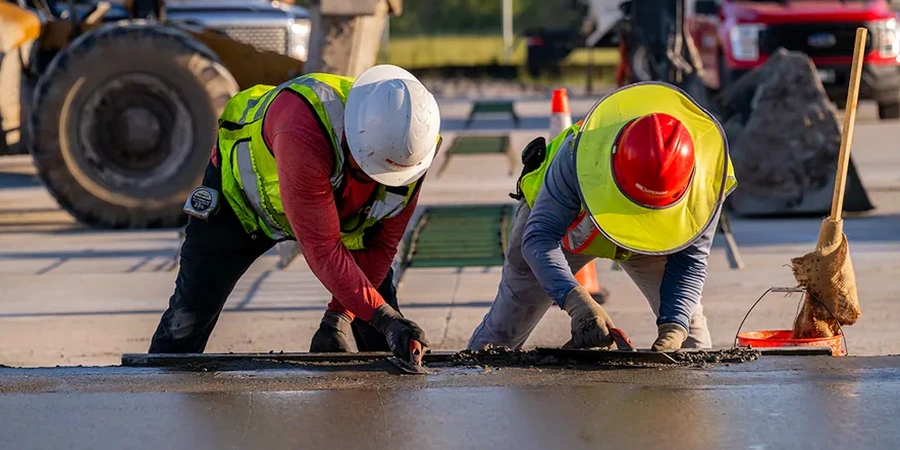
Local ground factors
A warehouse expansion in Ajax’s industrial sector near Salem Road once required demolition of a 200-meter rigid pavement bay only two years after placement. The concrete mix met the 35 MPa compressive strength spec, but no one checked the sulfate resistance requirement for the fill material imported from a local quarry. The resulting ettringite formation caused map cracking across 40 percent of the slab area. We see similar issues when designers apply a blanket k-value of 55 MPa/m without site-specific plate load testing — the actual k-value on the silty clay deposits south of the 401 often runs closer to 20 MPa/m in spring thaw conditions. This mismatch between design assumption and field reality produces corner breaks and faulting at transverse joints within the first five freeze-thaw cycles. Ontario’s MTO rigid pavement design procedure, based on the AASHTO 1993 guide supplemented by mechanistic checks, explicitly requires local calibration of the drainage coefficient — a step that gets skipped more often than anyone admits.
Reference standards
CSA A23.1:19 — Concrete Materials and Methods of Concrete Construction, ASTM C78/C78M-22 — Standard Test Method for Flexural Strength of Concrete, OPSS 350 — Concrete Pavement (Ontario Provincial Standard), AASHTO 1993 Guide for Design of Pavement Structures (Rigid Pavement Chapter)
Other technical services
Subgrade Reaction and Plate Load Testing
Field determination of the modulus of subgrade reaction using a 760 mm diameter plate per ASTM D1196. We also run companion DCP tests at each plate location to map the vertical k-value profile across the zone of stress influence of the concrete slab.
Concrete Durability and Strength Package
Cylinder casting, curing, and flexural strength breaks at 7 and 28 days per CSA A23.2-3C and ASTM C78. We include rapid chloride permeability testing (ASTM C1202) when the pavement will see de-icing salts — standard on Ajax arterial roads.
Subbase and Fill Quality Control
Gradation analysis of Granular A subbase per OPSS 1010, modified Proctor compaction control (ASTM D1557), and nuclear density testing during placement. We also verify the subbase permeability coefficient for drainage layer design.
Typical parameters
Questions and answers
What is the difference between rigid and flexible pavement testing requirements in Ajax?
Rigid pavement testing focuses on concrete flexural strength, the modulus of subgrade reaction, and joint load transfer, while flexible pavement relies on the CBR method and asphalt modulus. For Ajax sites on glacial till, we perform both because the subgrade behavior differs fundamentally between the two pavement types — a rigid slab bridges weak spots, while a flexible pavement transmits stress directly to each point on the subgrade.
How much does a rigid pavement design testing package cost for a typical Ajax commercial parking lot?
For a standard commercial parking lot rigid pavement package — including plate load tests for k-value determination, concrete flexural strength verification, and subbase gradation analysis — you are looking at a range of CA$2,770 to CA$7,600. The final figure depends on the number of plate load test locations and whether sulfate testing of the native soil is required.
Do you test the drainage layer under the concrete slab?
Yes, the drainage layer is critical for rigid pavement performance in Ajax because the frost-susceptible silts common here hold water against the underside of the slab. We test the permeability of the open-graded drainage layer and verify that it meets the OPSS 1010 gradation specification. We also check that the separator geotextile between the subgrade and the drainage layer has not been damaged during placement.
What is a k-value and why does it matter for my Ajax project?
The modulus of subgrade reaction, or k-value, is the pressure required to produce a unit deflection in the soil supporting a concrete slab. It directly controls the Westergaard stress calculations that determine slab thickness. In Ajax, the k-value varies dramatically between the well-drained sand lenses of the moraine and the saturated varved clays found in lower-lying areas — assuming a single value without field testing is the fastest way to an under-designed or over-designed pavement section.