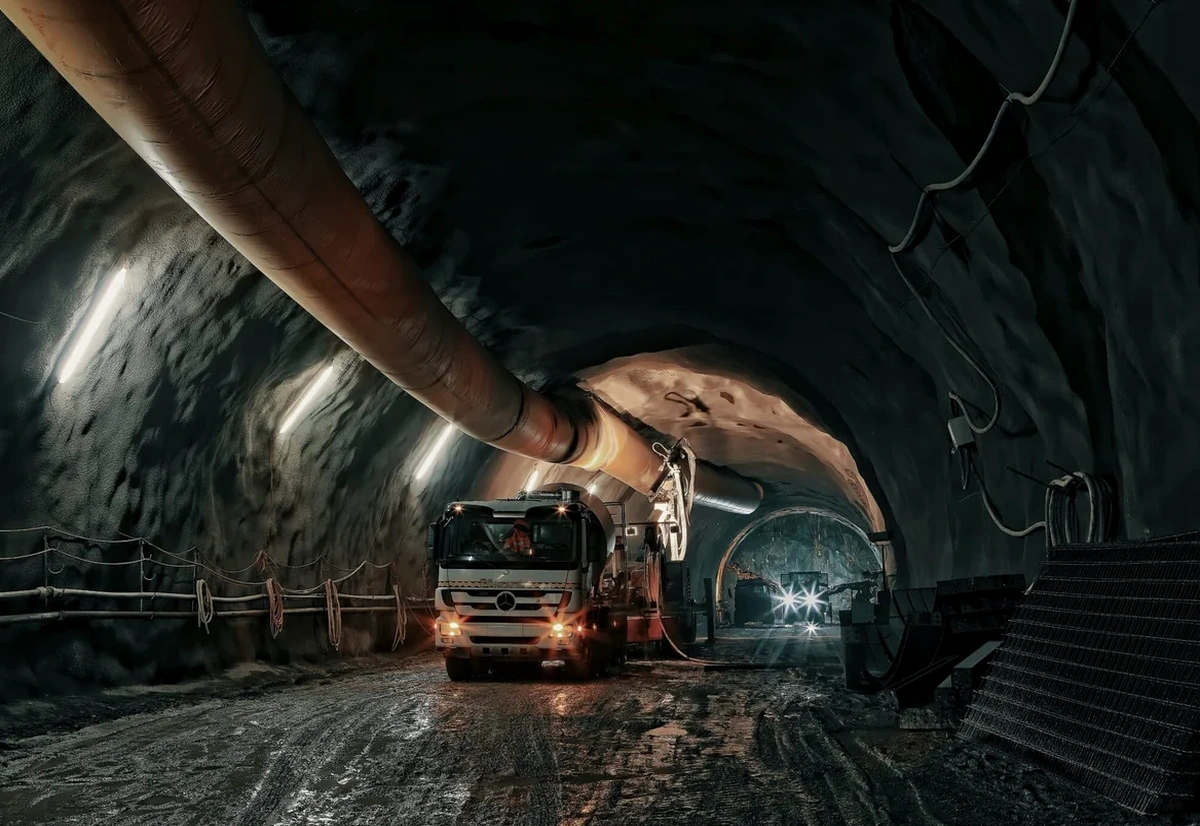
A tunnel boring machine advancing through saturated Lake Iroquois clay deposits demands far more than a standard geotechnical report. In Ajax, where the surficial geology transitions from glaciolacustrine silts to dense Halton Till within a few hundred meters, the face pressure and grouting parameters change block by block. Our team has supported multiple TBM and sequential excavation drives across the Greater Toronto Area, including under the Highway 401 corridor where settlement tolerances are measured in single-digit millimeters. We do not just classify the soil: we model the undrained response during crown advance, quantify stand-up time in the South Slope clay plain, and specify conditioning requirements that keep the cutterhead torque within operational limits. Before mobilizing the TBM, the CPT testing program we design provides continuous pore pressure dissipation data that no discrete SPT can match, and the MASW survey maps the shear wave velocity profile required for seismic deformation analysis under the NBCC 2020 provisions for Durham Region sites.
Face stability in Ajax's glaciolacustrine silts depends on pore pressure control more than on intact strength: manage the water and the ground manages itself.
Process and scope
Local ground factors
The most costly error we see in Ajax tunnel projects is specifying a uniform face pressure across an alignment that crosses three different soil units without adjusting for the groundwater gradient. A contractor running an EPB machine at 1.8 bar through the Halton Till may lose face stability the moment the cutterhead enters the underlying stratified silt, because the pore pressure regime shifts from hydrostatic to artesian within a 20-meter transition zone. The result is a blowout at the surface, a flooded heading, and a repair bill that often exceeds the original geotechnical investigation budget by a factor of ten. A second failure mode we encounter is underestimating the sensitivity of the glaciolacustrine clays: these deposits lose 60% to 80% of their undisturbed strength when remolded, so any over-excavation or prolonged stand-up time triggers progressive softening that propagates upward toward the surface. Our liquefaction assessment protocol evaluates this cyclic softening risk specifically for the fine-grained soils of the Durham Region, using the site-specific peak ground acceleration from the NBCC 2020 seismic hazard model calibrated to Ajax's coordinates.
Reference standards
NBCC 2020 (National Building Code of Canada, seismic provisions for Ajax site class D/E), ASTM D4767-11 (Consolidated-Undrained Triaxial Compression Test on Cohesive Soils), ASTM D5778-20 (Electronic Friction Cone and Piezocone Penetration Testing of Soils), CSA A23.3-19 (Design of Concrete Structures, tunnel lining provisions), ASTM D2487-17 (Standard Practice for Classification of Soils for Engineering Purposes)
Other technical services
Tunnel Face Stability and Settlement Analysis
We compute the required face support pressure for EPB and slurry TBMs using wedge-block and limit equilibrium methods calibrated to Ajax's glaciolacustrine silt parameters. Outputs include transverse settlement trough prediction based on Gaussian curve fitting, volume loss estimation from CPT tip resistance correlations, and building damage classification per the Boscardin and Cording criteria for structures within the influence zone.
Laboratory Testing Program for Tunnel Design Parameters
Our ISO/IEC 17025 accredited laboratory runs the full suite of advanced tests required for soft ground tunneling: CIU triaxial with pore pressure measurement per ASTM D4767, one-dimensional consolidation (ASTM D2435) to define the overconsolidation ratio and compression index, constant-head permeability (ASTM D5084) on undisturbed Shelby tube samples, and Atterberg limits (ASTM D4318) to correlate with TBM clogging potential.
Typical parameters
Questions and answers
What is the typical cost range for a geotechnical investigation supporting a soft ground tunnel in Ajax?
For tunnel projects in Ajax, the geotechnical investigation and analysis package typically ranges from CA$6,190 to CA$24,850, depending on the alignment length, number of boreholes, depth of investigation, and the laboratory testing program required. A 1-kilometer sewer tunnel with four investigation points and a full triaxial suite sits near the midpoint of this range.
How do you determine the stand-up time for an excavation in Ajax's glaciolacustrine silts?
Stand-up time is estimated using the convergence-confinement method, which requires the undrained shear strength from CIU triaxial tests, the in situ stress ratio from CPT pore pressure dissipation data, and the tunnel diameter. For Ajax's low-plasticity silts with Su values between 20 and 40 kPa, typical unsupported stand-up times range from 30 minutes to 4 hours, and we specify the maximum advance length per excavation cycle accordingly.
What seismic provisions apply to tunnel design in Ajax under the NBCC 2020?
Ajax falls within the seismic hazard region of southern Ontario, and NBCC 2020 requires site-specific ground motion parameters for tunnel design in soft soil conditions. We determine the site class through MASW shear wave velocity profiling, compute the design peak ground acceleration for the 2,475-year return period, and evaluate both the ovaling and racking deformation of the tunnel lining using the free-field shear strain method.
How do you address the risk of TBM clogging in Ajax's clay-rich formations?
Clogging potential is assessed through Atterberg limits testing and the correlation between plasticity index and adhesion potential. For Ajax's glaciolacustrine clays with PI values between 10% and 22%, we specify foam conditioning parameters including the foam expansion ratio and injection rate, and we recommend anti-clay polymers when the consistency index drops below 0.6, which indicates sticky behavior at the cutterhead.