In-situ testing represents a cornerstone of modern geotechnical engineering in Ajax, Ontario, offering direct measurement of soil and rock properties without the disturbance associated with sample extraction and laboratory analysis. This category encompasses a range of field-based investigative techniques designed to evaluate ground conditions at their natural state, providing engineers with reliable data on density, permeability, strength, and deformation characteristics. For a rapidly developing municipality like Ajax, where residential subdivisions, commercial plazas, and infrastructure upgrades are constant, the accuracy of in-situ testing directly influences foundation design, earthwork specifications, and long-term structural performance. Understanding the subsurface profile before construction begins is not merely a regulatory checkbox but a fundamental risk management strategy in a region shaped by glacial and post-glacial processes.
The geological framework of Ajax is dominated by the legacy of Pleistocene glaciation, which deposited a complex sequence of glacial till, glaciofluvial sands and gravels, and glaciolacustrine silts and clays. These deposits overlie the Ordovician bedrock of the Lindsay Formation, typically encountered at depths varying from 10 to over 30 metres across the town. The surficial geology map of the area reveals extensive tracts of sandy silt till, interspersed with ice-contact stratified drift along the former Lake Iroquois shoreline—a prominent physiographic feature that runs through Ajax. These conditions create significant spatial variability in soil behaviour, making site-specific in-situ evaluation essential. Permeable sand lenses within lower-permeability till matrices, for example, can create perched groundwater conditions that are only detectable through field methods like the field permeability test (Lefranc/Lugeon).
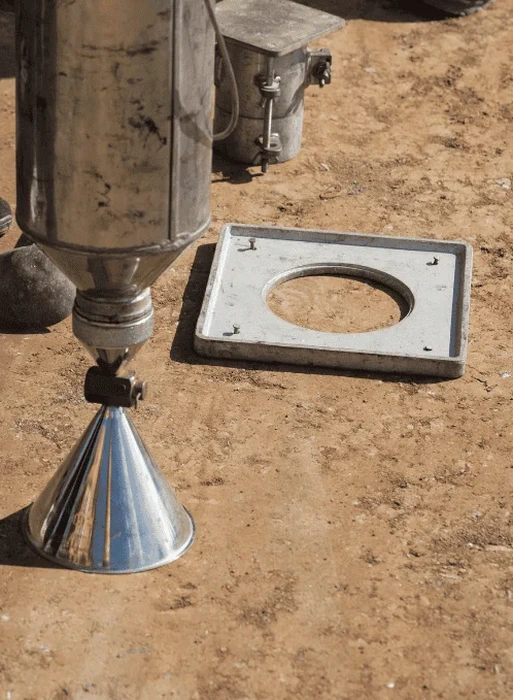
Canadian geotechnical practice in Ontario is governed by a suite of national and provincial standards that ensure consistency and reliability in field investigations. The Canadian Foundation Engineering Manual (CFEM) provides overarching guidance, while specific test procedures are detailed in ASTM International standards adopted by reference. For field density determination, ASTM D1556 outlines the standard test method using the sand cone apparatus, a procedure frequently employed in Ajax for compaction control on road embankments and building pads. Permeability testing in boreholes follows methodologies adapted from the Bureau de Normalisation du Québec (BNQ) standards or the U.S. Bureau of Reclamation’s Earth Manual, with the Lefranc test for soils and the Lugeon test for rock mass permeability. Ontario Regulation 903/90 under the Water Resources Act also imposes requirements for subsurface investigations where groundwater quality or flow may be impacted, indirectly mandating rigorous in-situ hydraulic conductivity assessments.
The range of projects in Ajax that demand in-situ testing is broad and reflects the town’s mixed urban and suburban character. Low-rise residential developments routinely require field density testing using the sand cone method to verify engineered fill placement meets specified relative compaction, typically 95% or 98% of Standard Proctor maximum dry density. Mid-rise condominium projects along the Highway 2 corridor necessitate detailed permeability profiling to design permanent dewatering systems for underground parkades, where the Lefranc test becomes indispensable. Infrastructure undertakings, such as the expansion of the Ajax Waterfront Trail or upgrades to the Duffins Creek pollution control plant, rely on in-situ strength testing and permeability assessments to ensure stability and environmental compliance. Even smaller-scale projects like stormwater management pond retrofits depend on accurate field hydraulic conductivity values to model infiltration rates effectively.
Questions and answers
What is the difference between in-situ testing and laboratory testing in geotechnical investigations?
In-situ testing measures soil or rock properties in their natural state without removing samples, preserving factors like stress conditions, moisture content, and fabric. Laboratory testing, conversely, analyzes extracted samples under controlled conditions. In Ajax's variable glacial deposits, in-situ methods often provide more representative data for parameters like permeability and density, as sample disturbance can significantly alter results, particularly in sensitive silts or loose sands.
Which in-situ tests are most commonly required for residential construction projects in Ajax?
For single-family home subdivisions in Ajax, the most frequently specified in-situ tests include field density testing via the sand cone method to verify compaction of engineered fill beneath footings and slabs, and Lefranc permeability tests in boreholes to assess drainage characteristics for foundation design. These tests are typically mandated by the project's geotechnical consultant to comply with the Ontario Building Code's requirements for bearing capacity and groundwater control.
How do local geological conditions in Ajax influence the selection of in-situ testing methods?
Ajax's geology, characterized by glacial till, glaciofluvial sands, and glaciolacustrine deposits, creates highly variable subsurface profiles. This variability necessitates a combination of tests: sand cone density tests are critical where engineered fill overlies compressible native soils, while Lefranc or Lugeon permeability tests are essential in sandy lenses or fractured bedrock to evaluate groundwater flow, especially near the former Lake Iroquois shoreline where hydrogeological conditions can change abruptly.
What Canadian standards govern in-situ testing procedures in Ontario?
In Ontario, in-situ testing procedures primarily reference ASTM International standards, such as ASTM D1556 for sand cone density testing. The Canadian Foundation Engineering Manual (CFEM) provides comprehensive guidance on test selection and interpretation. For permeability testing, methodologies from the U.S. Bureau of Reclamation or BNQ standards are commonly adopted. Provincial regulations like Ontario Regulation 903/90 may also dictate specific investigation requirements where groundwater is involved.