When a geotechnical investigation encounters fine-grained soils in Ajax, particularly the glaciolacustrine silts and clays deposited by the former Lake Iroquois shoreline, classification under the Unified Soil Classification System (USCS) demands precise Atterberg limits. ASTM D4318-17e1 specifies the Casagrande cup method for liquid limit and the thread-rolling procedure for plastic limit — both of which our laboratory executes under strict humidity and temperature controls. With Ajax sitting at roughly 43.85°N latitude and subject to freeze-thaw cycles penetrating up to 1.2 metres, the plasticity characteristics of the surficial soils directly influence frost heave susceptibility and the long-term performance of shallow foundations. We routinely pair this test with grain size analysis to confirm fines content before interpreting the plasticity chart and assigning a definitive USCS group symbol for the client’s geotechnical report.
Atterberg limits transform a handful of disturbed soil into a defensible classification that governs everything from bearing capacity assumptions to excavation stability in Ajax’s layered Quaternary deposits.
Process and scope
Local ground factors
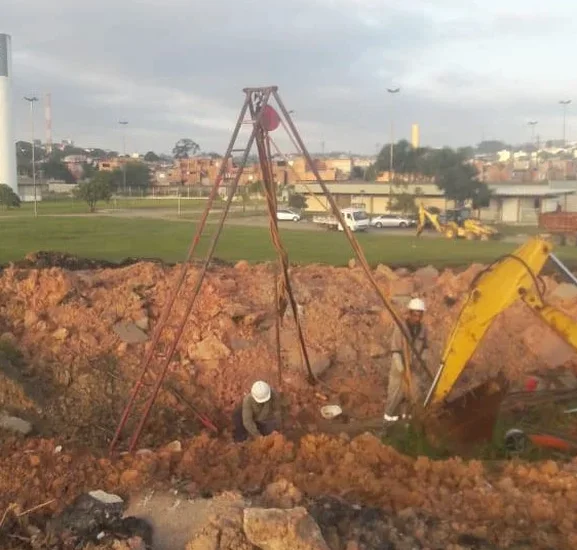
A condominium excavation on Westney Road encountered a lens of grey silty clay at 3.5 metres depth that field logging alone misidentified as low-plasticity silt. The contractor proceeded with a vertical cut assuming short-term stand-up time, but within 48 hours of exposure to spring meltwater, the face began spalling and a 2-metre section collapsed into the trench. Laboratory Atterberg testing subsequently revealed a liquid limit of 55% and a plasticity index of 28%, classifying the material as CH — fat clay with high shrink-swell potential. Had the limits been run during the initial investigation phase, the shoring design would have incorporated a higher lateral earth pressure coefficient and mandatory bench cuts. In Ajax’s post-glacial landscape, where stratigraphy can shift from sandy till to plastic clay within a single borehole, skipping Atterberg classification on fine-grained samples introduces an unnecessary risk of mischaracterization that can cascade into excavation instability, foundation distress, and regulatory non-compliance under the Ontario Building Code.
Reference standards
ASTM D4318-17e1: Standard Test Methods for Liquid Limit, Plastic Limit, and Plasticity Index of Soils, ASTM D2487-17: Standard Practice for Classification of Soils for Engineering Purposes (Unified Soil Classification System), Ontario Building Code (OBC) Division B, Part 4 — reference to CSA A23.3 and geotechnical investigation requirements, MTO LS-703 (where applicable for Ministry of Transportation Ontario projects)
Other technical services
Multipoint Liquid & Plastic Limit
Full ASTM D4318 Method A with four-point flow curve, plastic limit by thread-rolling, and computed plasticity index. Includes USCS classification per D2487 and a brief interpretive note on expected engineering behavior relevant to Ajax subgrade and foundation conditions.
One-Point Liquid Limit (Screening)
Rapid one-point method per ASTM D4318 Annex A2, calibrated against a validated flow curve for the same geologic unit. Suitable for preliminary site screening or borrow-source evaluation when project timelines require same-day turnaround.
Afterberg + Moisture Content + Fines Correlation Package
Combined package that pairs Atterberg limits with natural moisture content and percent passing No. 200 sieve. Allows computation of liquidity index and activity (PI / % clay) — critical parameters for assessing undrained strength and swell sensitivity in Ajax’s glaciolacustrine clays.
Typical parameters
Questions and answers
What is the typical turnaround time for an Atterberg limits test on Ajax samples?
Standard turnaround is 3 to 5 business days from sample receipt to certified report. Rush processing with a 24-hour turnaround is available for active construction projects where excavation decisions depend on rapid soil classification. The timeline includes oven-drying, pulverizing, hydrating to equilibrium, and running the full multipoint liquid limit flow curve.
How much does Atterberg limits testing cost in Ajax?
A single multipoint liquid limit and plastic limit test runs between CA$100 and CA$120 per sample, depending on whether it is part of a larger geotechnical testing package. Volume discounts apply for projects submitting 10 or more fine-grained samples from the same site investigation.
Does the test method change if the Ajax soil contains organic material?
ASTM D4318 is applicable to soils with up to approximately 50% organic content. If visual inspection or loss-on-ignition suggests higher organics, we oven-dry at 60°C instead of the standard 110°C to avoid burning off organic matter, and we note the lower drying temperature on the report. For peats and highly organic soils, separate organic content determination per ASTM D2974 is recommended alongside the Atterberg limits.
Can you run Atterberg limits on samples that have already been used for other tests?
Yes, provided the sample has not been contaminated with chemicals, dried above 60°C, or mechanically altered beyond standard preparation. We often run Atterberg limits on the same Shelby tube specimen used for unconfined compression, taking the trimmings from the specimen preparation stage. The key requirement is that the material passes a No. 40 sieve and is representative of the fine fraction of the deposit encountered in Ajax.