A Komatsu crawler-mounted drill rig, typically a CR-70 or similar, moves into position on a residential lot near the Ajax waterfront. The rotary head spins, advancing a hollow-stem auger through silty clay before the crew switches to a down-hole hammer to socket into the underlying shale. That transition, from soft overburden to competent bedrock, defines the pile design challenge across Ajax. We run PDA (Pile Driving Analyzer) tests on driven H-piles and analyze load-transfer curves for drilled shafts, calibrating each design to the specific stratigraphy found along the Lake Ontario shoreline. The local geology here in Ajax, part of the Iroquois Plain, is unforgiving to generic designs. You need a pile type, length, and installation method that accounts for the abrupt contact between the glacial lake deposits and the Georgian Bay Formation shale. We combine this site-specific data with our in-situ permeability testing to evaluate groundwater cut-off requirements during pile installation near the Duffins Creek corridor.
Pile design in Ajax is not about picking a capacity from a table; it is about modeling the load transfer through 10,000 years of glacial lake stratigraphy.
Process and scope
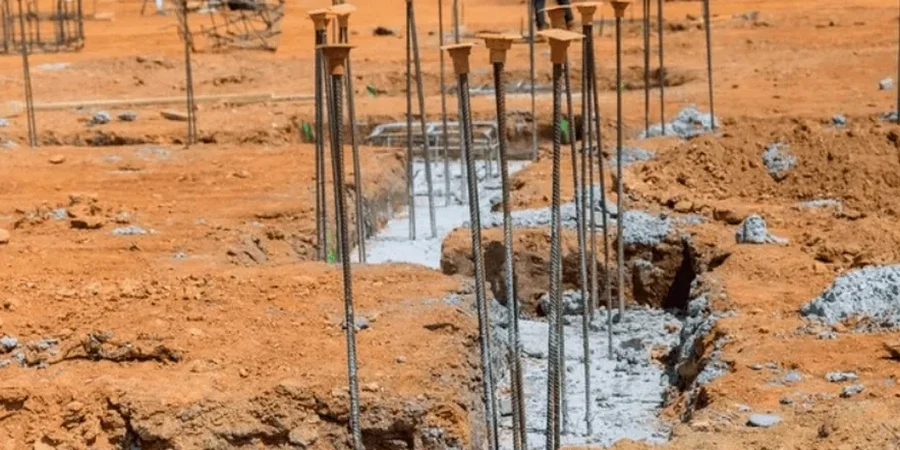
Local ground factors
The development history of Ajax, from a WWII munitions plant to a modern suburban hub, left a legacy of fill and disturbed ground across the southern industrial lands. What looks like native till on a 1950s aerial photo might be uncontrolled fill with bricks, slag, or organic pockets. Boring into that with a continuous flight auger can cause sidewall collapse before the concrete is poured, leading to necking in the pile shaft. We address this risk by specifying temporary casing through the fill zone and verifying the concrete integrity with cross-hole sonic logging. Another issue is downdrag. The compressible clay layers along the Harwood Avenue corridor are still consolidating under the weight of recent embankment fills. We calculate the neutral plane location and add a bitumen coating or a double casing system to isolate the pile from the settling soil. The design must also account for the aggressive groundwater chemistry in the Lake Ontario basin, with sulfate concentrations that require Type HS cement in the pile concrete to prevent long-term degradation.
Reference standards
NBCC 2020 (Division B, Part 4), CSA A23.3-19 (Design of Concrete Structures), FHWA-NHI-16-010 (Drilled Shaft Manual), ASTM D3966-22 (Lateral Load Testing of Piles), CFEM (Canadian Foundation Engineering Manual, 4th Ed.)
Other technical services
Axial and Lateral Capacity Analysis
Using LPILE and SHAFT software to generate load-settlement curves and bending moment profiles for single piles and pile groups, calibrated to site-specific CPTu and laboratory test results.
Pile Load Test Design and Interpretation
Designing static load test programs (ASTM D1143) and high-strain dynamic tests (ASTM D4945) to verify design assumptions, including instrumented tests with strain gauges to separate shaft and base resistance.
Construction Specifications and Inspection
Preparing technical specifications for driven and bored piles, including acceptance criteria based on wave equation analysis and cross-hole sonic logging to verify shaft integrity.
Typical parameters
Questions and answers
What is the typical cost range for a pile foundation design package for a residential project in Ajax?
For a single-family home or a small commercial building in Ajax, a complete pile foundation design package, including the geotechnical investigation, capacity analysis, and sealed construction drawings, typically falls between CA$1.990 and CA$9.220. The final cost depends on the number of boreholes required, the depth to bedrock, and whether dynamic load testing is specified.
How deep do piles need to go in Ajax to reach competent bedrock?
It varies significantly. In the northern parts of Ajax, near Taunton Road, the overburden can be as thin as 3 to 5 meters. South of the 401 and toward the lake, the bedrock surface drops to 20 meters or more. We always recommend a minimum 3-meter socket into sound shale of the Georgian Bay Formation to develop the full base resistance.
Do I need a seismic pile design for a building in Ajax?
Yes, under the NBCC 2020, Ajax falls within a moderate seismic hazard zone. While the peak ground acceleration is not high, the presence of soft clay over stiff shale can amplify ground motions. Our designs include a kinematic interaction analysis to ensure the piles can handle the curvatures imposed by the seismic waves without structural damage.
What type of pile is most common in Ajax, driven or bored?
Both are common, but the choice is site-specific. Driven steel H-piles are efficient for end-bearing on shale where the overburden is less than 15 meters. For deeper deposits or where vibrations are a concern, we specify bored piles. In the fill areas near the old industrial lands, we often use cased bored piles to prevent groundwater and soil infiltration.