We see too many projects in Ajax where the foundation design is based on assumed bearing pressures from a textbook. Then the excavation hits a lens of saturated silt or loose fill, and suddenly the assumed 150 kPa is cut in half. The redesign costs time and money that should have been avoided with a proper site investigation upfront. Shallow foundation design here must account for the real stratigraphy beneath the footing, not a generic soil profile. Our approach ties the design directly to field data from test pits and lab results, so the geotechnical model reflects what is actually in the ground under your Ajax site.
Designing shallow foundations in Ajax without measuring the depth to groundwater is like checking slope stability without knowing the soil friction angle — the numbers won't mean anything.
Process and scope
Local ground factors
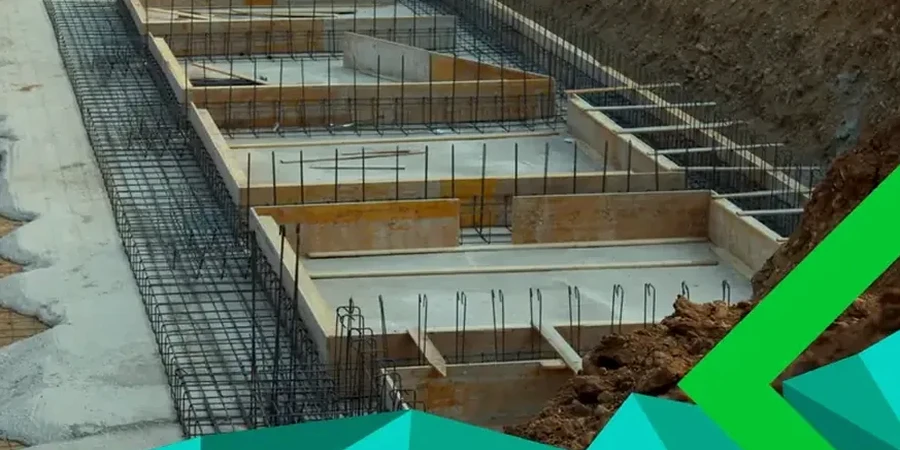
In Ajax, the biggest shallow foundation risk we encounter is differential settlement from variable fill thickness. Many residential subdivisions built in the 1970s and 1980s sit on 0.5 to 2 metres of uncontrolled fill placed over the natural till. That fill is rarely uniform. When a footing spans from a zone of thin fill onto a zone of thick fill, the differential movement can crack the superstructure within the first five years. Another local problem is softening of the Georgian Bay shale surface when it is exposed to air and water during excavation; we specify a mud slab or a protective concrete seal within 24 hours of exposure. Finally, frost heave in Ajax is real — the Ontario Building Code requires a minimum 1.2 m depth to the underside of footing, and we never reduce that without a heated-structure exemption documented by the design engineer.
Reference standards
NBCC 2020 – Division B, Part 4, CSA A23.3:2019 – Design of Concrete Structures, ASTM D2488 – Visual-Manual Description of Soils, Canadian Foundation Engineering Manual (CFEM), 4th Edition, Ontario Building Code (O.Reg. 332/12)
Other technical services
Bearing Capacity and Settlement Analysis
We compute allowable bearing pressures using both shear failure criteria and serviceability settlement limits, incorporating CPT and SPT data collected on your Ajax site. The analysis includes groundwater correction and seismic bearing capacity reduction where NBCC 2020 requires it.
Isolated and Strip Footing Design
Reinforced concrete footing dimensions, bar schedules, and embedment depths are developed in accordance with CSA A23.3. We coordinate directly with your structural engineer so the geotechnical and structural assumptions are consistent.
Construction Phase Geotechnical Review
We inspect the bearing surface during excavation to confirm the ground conditions match the design assumptions. If soft spots, fill pockets, or shale degradation are observed, we provide immediate field recommendations to keep the project moving.
Typical parameters
Questions and answers
What is the typical cost range for a shallow foundation design in Ajax?
For a single-family or small commercial project in Ajax, the geotechnical investigation and foundation design package typically falls between CA$2,280 and CA$3,690. The final figure depends on the number of test pits or boreholes needed and whether a topographic survey is included.
How deep do footings need to be in Ajax to avoid frost heave?
The Ontario Building Code sets a minimum footing depth of 1.2 m below finished grade for unheated structures. For heated buildings, this can sometimes be reduced, but the reduction must be justified by thermal analysis and documented by a Professional Engineer. We never go shallower than 900 mm even with a heated exemption, because Ajax winters can push the frost line deeper during sustained cold snaps.
Is a seismic bearing capacity reduction required for Ajax sites?
Yes, for Site Class D and E soils in Ajax, NBCC 2020 requires a one-third reduction in allowable bearing pressure for seismic load combinations. We run this check on every project and flag it in the geotechnical report, so the structural engineer has the correct values for the seismic load case.
What if we encounter uncontrolled fill during excavation?
If the fill is thicker than 300 mm under a footing, we typically recommend over-excavation and replacement with engineered granular fill compacted to 98% Standard Proctor density. For fill deeper than 1.5 m, we may switch to a deep foundation alternative, but we always evaluate the cost of excavation versus the cost of redesign before making that call.