The 2020 Ontario Building Code, referencing CSA A23.3, emphasizes that groundwater control is a critical design parameter for any deep foundation or excavation within the Duffins Creek watershed. In Ajax, where the geological profile transitions rapidly from dense glacial till of the Lake Iroquois plain to the sensitive silts near the Lake Ontario shoreline, assuming a uniform hydraulic conductivity is a project risk. Our field permeability testing program—specifically the Lefranc test in soils and the Lugeon test in fractured rock—provides the direct, in-situ measurements that geotechnical designers need to move beyond conservative textbook estimates. By isolating specific test intervals within a borehole, often advanced during a sondaje SPT investigation, we quantify the true flow characteristics of the strata before a single footing is poured or a dewatering pump is sized.
In-situ packer testing reveals fracture flow regimes that lab permeameters miss entirely—critical for dewatering design in the Lake Iroquois plain.
Process and scope
Local ground factors
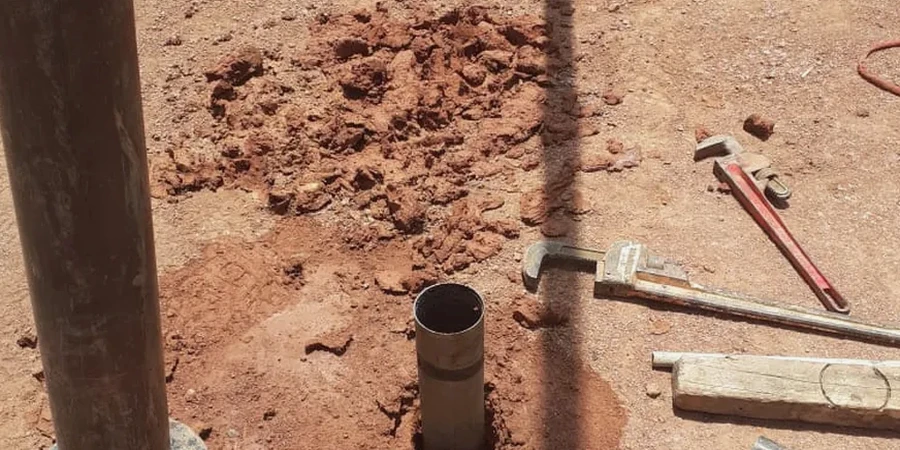
The field kit centers on a dual-packer assembly lowered down a stabilized NQ or HQ borehole, connected to a calibrated water meter and a pressurized supply line at the surface. In Ajax, where the water table often sits just 2 to 3 meters below grade near the waterfront parks, maintaining borehole stability during packer inflation is the first critical hurdle. The largest technical risk is hydraulic fracturing or jacking of the overburden during a Lugeon test in weak shale if the maximum test pressure exceeds the minor principal in-situ stress. Our technicians continuously plot flow versus pressure on a Houlsby diagram in real-time; a non-linear, dilating curve immediately halts the pressure step to prevent artificial enhancement of the rock mass permeability. For Lefranc testing in silty conditions, we guard against sediment clogging the intake screen, as a partially blocked filter can mimic a low-conductivity layer and lead to an undersized, failing dewatering system.
Video overview
Reference standards
ASTM D6391-11 (Field Permeability in Boreholes), ASTM D4630 (Rock Mass Permeability - Lugeon), CSA A23.3 (Design of Concrete Structures - Groundwater Considerations), Ontario Building Code 2020 (Section 4.2.4)
Other technical services
Lefranc Variable Head Testing
Designed for the unconsolidated sands, silts, and tills prevalent across Ajax. We perform this test immediately after soil sampling to measure the coefficient of permeability, providing critical data for the design of excavation dewatering systems and infiltration galleries in subdivisions north of Highway 401.
Lugeon Packer Testing in Bedrock
Applied to the fractured shale and limestone formations underlying the Durham Region. Using a double packer system, we isolate specific fracture zones to quantify water take under staged pressures, a non-negotiable step for validating grout curtain effectiveness and deep foundation socket drainage.
Typical parameters
Questions and answers
What is the typical cost range for a Lugeon or Lefranc permeability test in Ajax?
The cost for a field permeability test program in Ajax generally falls between CA$950 and CA$1,400 per test interval. The final price depends on borehole depth, the number of pressure stages, and whether access requires traffic control along arterial roads like Bayly Street or Harwood Avenue.
When should I specify a Lugeon test instead of a Lefranc test on my Ajax project?
You should specify a Lugeon test whenever the investigation encounters competent bedrock, typically the Georgian Bay Formation shale found at depths of 8 to 15 meters across Ajax. The Lugeon test uses a pressurized packer system to isolate fractures, whereas the Lefranc test is only suitable for the soil overburden and highly weathered rock interfaces.
How long does it take to get the permeability results after the field test?
We can provide preliminary field data, including the raw flow rates and calculated Lugeon values, within 24 hours of completing the test. The comprehensive geotechnical report, which includes the Houlsby flow diagrams, transmissivity analysis, and correlations with your soil stratigraphy, is typically delivered within five to seven business days.
Can you perform the test in an existing observation well, or do you need a new borehole?
For accurate Lefranc or Lugeon testing, we require a clean, cased borehole with a known diameter, usually advanced by rotary drilling or hollow-stem auger. Existing observation wells with slotted screens are unsuitable for packer testing because they cannot isolate a specific test interval, which defeats the purpose of measuring discrete fracture or stratum permeability.