Ajax sits on the former lakebed of glacial Lake Iroquois, right where the shoreline bluffs meet the flat plains north of Highway 401. That transition zone creates some of the most variable subsurface conditions in Durham Region: dense till in one lot, soft silty clay in the next. Before a shovel hits the ground, you need to know what is underneath. The Standard Penetration Test (SPT) remains the most practical tool for that job. We run it on sites from Pickering Beach to Audley North, giving you N-values and soil descriptions that match the NBCC 2020 framework. Paired with a CPT test when the stratigraphy is complex, SPT data lets you size footings with confidence. For larger commercial pads near the 401 corridor, we often combine it with a seismic refraction survey to get both strength and velocity profiles in one mobilization.
Ajax soils can shift from dense glacial till to compressible silt within 30 meters. SPT blow counts tell you exactly where that boundary lies.
Process and scope
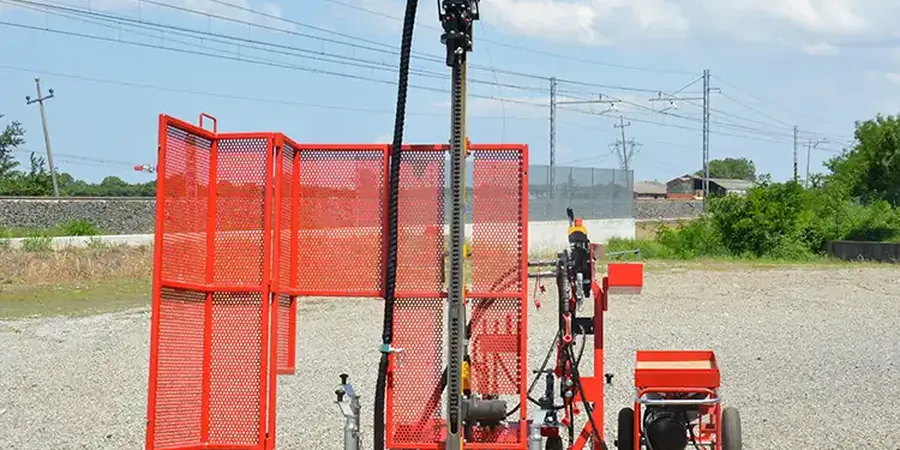
Local ground factors
We have seen too many jobs along Harwood Avenue where the geotechnical report was done three lots away and the builder assumed the soils would match. They almost never do. Ajax has old buried creek channels, pockets of organic silt where the waterfront marshes used to extend, and fill zones from 1950s development that nobody documented. SPT refusal on a boulder at 4 meters depth is another classic surprise near the Lake Ridge Road escarpment. If you skip the boreholes on your actual footprint, you are gambling with foundation performance. The cost of mobilizing a drill for even two SPT borings is trivial compared to repairing a settled slab or a cracked block wall two years after occupancy. We also flag liquefaction risk for sites in Seismic Category C, which covers most of Ajax, because the sandy units below the water table can lose strength during a moderate earthquake.
Reference standards
ASTM D1586-18: Standard Test Method for Standard Penetration Test (SPT) and Split-Barrel Sampling of Soils, NBCC 2020: National Building Code of Canada, Part 4 – Structural Design, seismic and foundation provisions, ASTM D4633-16: Standard Test Method for Energy Measurement for Dynamic Penetrometers, CSA A23.3-19: Design of Concrete Structures, referenced for foundation concrete in contact with sulfate-bearing Ajax soils
Other technical services
Residential SPT Investigation
Two to four boreholes on your Ajax lot, logged per ASTM D2488, with N-values and foundation recommendations for strip footings or full basements. Turnaround in five business days for standard single-family projects.
Commercial and Industrial SPT Program
Grid-pattern drilling for warehouses, retail pads, and mid-rise buildings. Includes SPT-based bearing capacity calculations, settlement estimates, and seismic site class determination per NBCC Table 4.1.8.4.A.
Liquefaction Screening Package
SPT data processed through the NCEER (Youd-Idriss 2001) simplified procedure for Ajax sites in Seismic Category C. Factor of safety against liquefaction reported for each sandy layer encountered.
Typical parameters
Questions and answers
How much does an SPT investigation cost for a single-family lot in Ajax?
For a typical Ajax residential lot with two to three boreholes to 10 meters depth, the SPT investigation ranges from CA$750 to CA$1,160, which includes the drilling crew, engineer logging, laboratory classification of samples, and a signed geotechnical report with foundation recommendations.
How many SPT boreholes does the Ajax building department require?
Ajax follows the Ontario Building Code, which references the NBCC and typically requires a minimum of one borehole per 200 square meters of building footprint, with at least two boreholes for any structure. For irregular sites near Duffins Creek or the lakefront, the building official may ask for additional investigation to rule out organic soils.
What is the difference between N-value and N60, and which one do you report?
The raw N-value is the total blow count from the field. N60 is the blow count normalized to 60% hammer energy efficiency, which corrects for the energy losses in the particular hammer system we use. Our Ajax reports include both values, with N60 used for liquefaction analysis and bearing capacity calculations per the Canadian Foundation Engineering Manual.