The glacial till and near-shore sediments underlying Ajax present a pavement design challenge that standard presumptive values simply cannot address. With the city perched along the Lake Ontario waterfront and intersected by Carruthers Creek and Duffins Creek, moisture regimes fluctuate significantly between the elevated drumlin areas and the low-lying floodplain corridors. A reliable laboratory CBR test becomes the cornerstone of any road or parking lot project here because it quantifies how the local silty sand and clayey silt subgrades will actually behave under saturated conditions. The Ontario Ministry of Transportation recognizes ASTM D1883 as the reference procedure, and our laboratory applies it with strict moisture conditioning that mirrors what happens during a wet spring in Durham Region. For projects where the pavement structure sits on variable fill, we often combine the CBR evaluation with a grain-size analysis to correlate fines content with strength loss potential.
A 1 percent drop in laboratory CBR can double the required granular base thickness in Ontario pavement design. Ajax subgrades demand that precision.
Process and scope
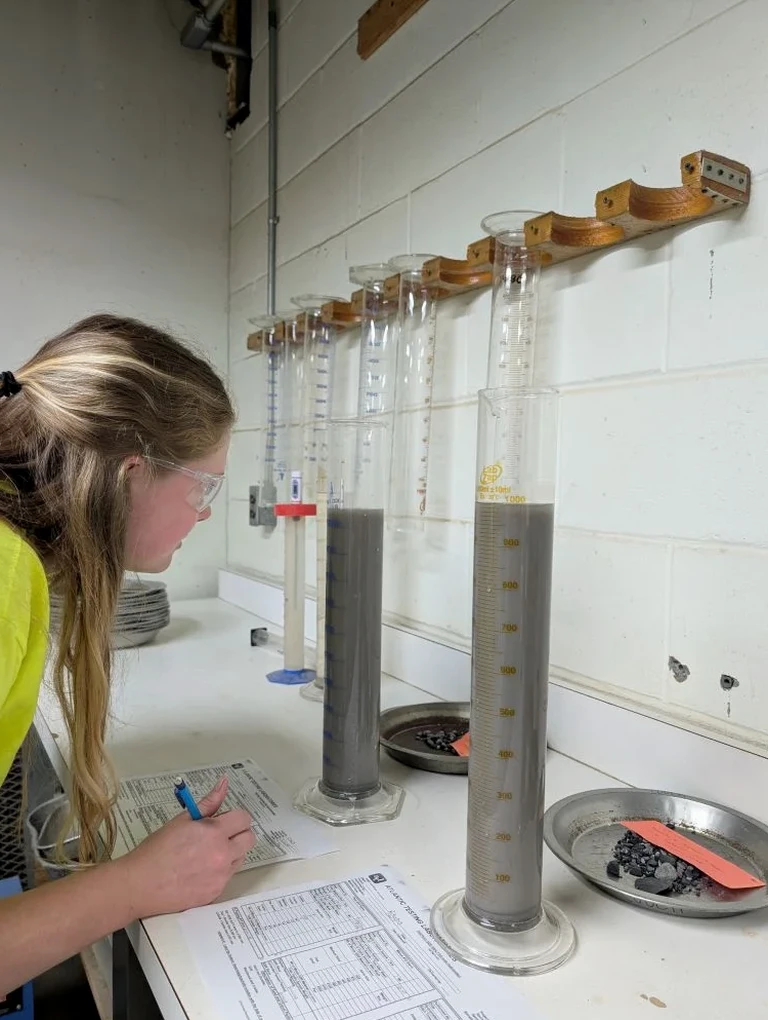
Local ground factors
A commercial plaza project on Harwood Avenue taught us a costly lesson about skipping the soaked CBR procedure. The geotechnical report relied on unsoaked CBR values taken from Shelby tube samples in late summer, when the water table was at its seasonal low. The pavement design used a 6 percent CBR, but by the following April, the silty clay subgrade had softened to less than 2 percent under the weight of delivery trucks. The asphalt cracked within eighteen months. What made this failure predictable was the soil's high plasticity—liquid limits above 40 are common in the glaciolacustrine deposits that underlie central Ajax. A laboratory CBR test with proper four-day soaking would have revealed the strength loss before the first ton of granular base was placed. Municipal projects in Ajax now routinely specify soaked CBR testing for any subgrade with more than 12 percent passing the No. 200 sieve, a threshold that captures nearly all of the fine-grained soils mapped by the Ontario Geological Survey in this part of Durham Region.
Video overview
Reference standards
ASTM D1883-21: Standard Test Method for California Bearing Ratio (CBR) of Laboratory-Compacted Soils, ASTM D698-12(2021): Standard Test Methods for Laboratory Compaction Characteristics of Soil Using Standard Effort, Ontario Ministry of Transportation (MTO) LS-701: Method of Test for California Bearing Ratio
Other technical services
Soaked Laboratory CBR (ASTM D1883)
Four-day soaked CBR determination on remolded samples compacted at target moisture and density. Includes swell measurement and correction for oversize particles when gravel fraction exceeds 20 percent, following MTO supplemental procedures.
CBR vs. Moisture Relationship
Multi-point testing at three or more moisture contents to establish the strength-moisture curve. Critical for Ajax sites where construction traffic must traverse the subgrade during different seasons.
Pavement Thickness Validation
Combined CBR and traffic loading analysis using the AASHTO 1993 design method, cross-referenced with MTO pavement design tables to verify or optimize the granular base and asphalt thickness for Ajax municipal and private projects.
Typical parameters
Questions and answers
What is the typical turnaround time for a laboratory CBR test in Ajax?
A standard soaked CBR test requires approximately seven to ten working days from sample receipt to final report. The four-day soaking period is fixed by ASTM D1883 and cannot be shortened. Sample preparation, compaction, and penetration testing add two to three days, and the report with load-penetration curves and calculated CBR values requires an additional day for review by the laboratory engineer.
How much does a laboratory CBR test cost for an Ajax project?
A single-point soaked CBR test typically ranges from CA$150 to CA$270, depending on whether the sample requires Standard or Modified Proctor compaction effort and whether swell measurement is included. Multi-point testing or rush processing may adjust the final cost. We recommend contacting the laboratory directly with the project details for a firm quotation.
Why is the 96-hour soaking period necessary for Ajax subgrades?
The 96-hour soaking period simulates the worst-case saturated condition that a subgrade will experience during its service life. In Ajax, where spring thaw and heavy rainfall can saturate the silty soils prevalent near the lake, omitting the soak can overestimate the CBR by 40 to 60 percent. The MTO and most Durham Region municipalities require soaked CBR values for pavement design precisely because unsoaked values lead to under-designed pavement sections.
Can laboratory CBR values be correlated with field CBR or DCP tests in Ajax?
Yes, but the correlation is soil-specific. In the sandy subgrades found near the Ajax waterfront, laboratory and field CBR values often align within 10 to 15 percent when both are tested at similar moisture conditions. In the silty clay deposits north of Highway 401, laboratory values tend to be lower than field values because the remolding process destroys any natural structure or desiccation crust. We recommend running paired laboratory and field tests on at least three locations per project to establish a site-specific correlation rather than relying on published generic equations.