Ajax sits on the glacial till and Lake Iroquois plain, where thick deposits of soft, compressible silty clay can extend well beyond 10 meters depth. The water table in many parts of town is high, often just 1.5 to 2 meters below grade. For any mid-rise or industrial slab, conventional footings on this material risk excessive differential settlement. Our team approaches stone column design as a controlled ground improvement exercise—we size the columns, define the grid, and specify the backfill gradation to transfer structural loads past the weak zone. The design sequence always starts with a CPT test to map the undrained shear strength profile, followed by settlement verification under service loads.
A well-designed stone column grid can reduce post-construction settlement by 60 to 80 percent versus untreated ground in Ajax's soft clay profile.
Process and scope
Local ground factors
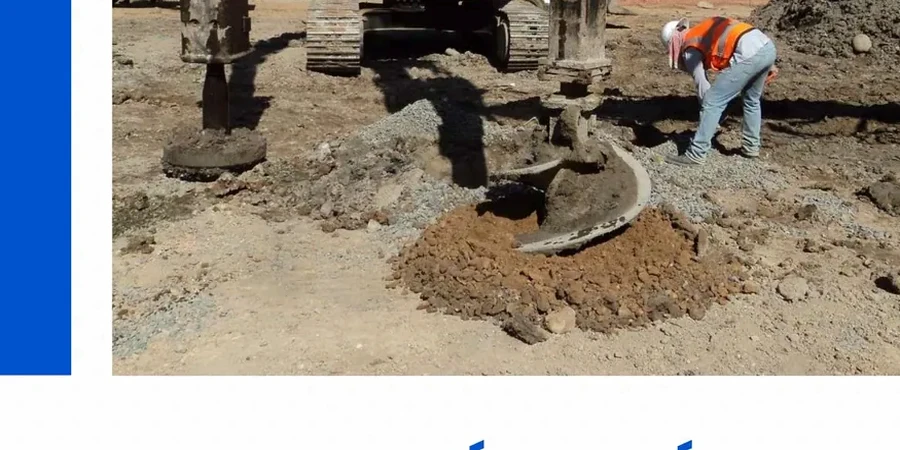
The most common mistake we see in Ajax is contractors treating stone columns as simple gravel piles without a design. They auger a hole, dump stone, and assume the ground is fixed. Without a proper load test and settlement monitoring plan, you cannot confirm the column actually engaged the load. We have pulled cores from projects where the stone column stopped two meters short of the design depth because the rig operator hit a stiff till lens and assumed refusal. That column does nothing for the soft clay below. Our QA/QC protocol includes electronic depth recording on the vibrator, post-installation CPT checks through the column center, and zone load tests on at least five percent of the production columns. If the load-settlement curve deviates from the design modulus, we adjust the grid before the next rig move.
Reference standards
NBCC 2020 Part 4, ASTM D448 Standard Classification for Sizes of Aggregate for Road and Bridge Construction, FHWA-NHI-16-010 Ground Improvement Methods
Other technical services
Feasibility and preliminary design
Review of geotechnical baseline, column diameter selection, trial grid spacings, and settlement improvement estimates for budgeting.
Detailed design and 3D modeling
PLAXIS 3D axisymmetric and full 3D models for irregular column layouts, sensitivity analysis on area replacement ratio, and lateral deformation checks.
QA/QC and field verification
Pre- and post-treatment CPT profiling, zone load testing per ASTM D1143, electronic vibrator logs, and final sign-off documentation.
Typical parameters
Questions and answers
What does a stone column design package cost in Ajax?
For a typical Ajax commercial or light industrial site, a complete design package—including feasibility, detailed design with PLAXIS modeling, and QA/QC specification—runs between CA$2,180 and CA$7,550. The range depends on the number of column zones, whether 3D modeling is needed for irregular grids, and the scope of load testing specified.
How deep can stone columns be installed in Ajax's soil conditions?
In Ajax's glacial till and Lake Iroquois plain deposits, stone columns are typically designed to depths of 6 to 18 meters. The limiting factor is usually the presence of very dense basal till—once the vibrator reaches refusal on competent till, the column is terminated. We confirm depth capacity from CPT refusal data during the investigation phase.
How do you verify the columns are performing as designed?
We specify pre- and post-treatment CPT soundings through the center of selected columns to compare tip resistance and sleeve friction profiles. Additionally, zone load tests on isolated columns or column groups confirm the load-settlement behavior matches the design modulus. Electronic vibrator logs provide real-time depth and amperage records for every column installed.