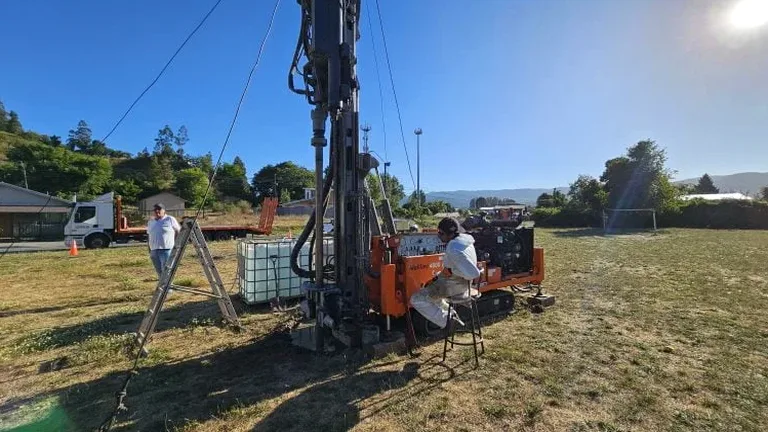
The glacial till and Lake Ontario shoreline deposits across Ajax demand direct visual inspection of the subsurface. Test pit excavation provides that view. Our team digs to target depths in the Duffins Creek watershed zone, exposing stratigraphy that split-spoon samplers can miss. Ajax soils transition fast — from sandy silts near the waterfront to dense till north of Highway 401. A calibrated excavator bucket and a geologist on the pit wall are the fastest way to map that change. For deeper refusal layers, we pair test pits with spt drilling to extend the profile beyond the reach of the backhoe.
A 3-meter test pit in Ajax often reveals the contact between post-glacial lake sediments and the underlying Halton Till — a boundary that governs foundation bearing and drainage design.
Process and scope
Local ground factors
Ajax grew fast in the post-war decades. Many older neighborhoods near Rotary Park sit on undocumented fill placed over creek valleys or wetland edges. Test pits open a window into those buried conditions. We have uncovered organic silt lenses, construction debris, and abandoned service trenches that would go undetected by spaced borings. The Ontario Building Code requires soil identification for foundation design on any lot where bearing strata are uncertain. Skipping direct observation in these transitional zones risks differential settlement and moisture entrapment. A single well-placed exploratory pit near the foundation footprint eliminates that uncertainty before concrete is poured.
Video overview
Reference standards
ASTM D2488 (visual-manual soil description), Ontario Building Code 9.4.4 (soil bearing), CSA A23.3 (concrete on soil)
Other technical services
Stratigraphic profiling pit
Single or multiple pits positioned along the foundation axis to log natural soil, fill thickness, and groundwater depth. Photo documentation with GPS tags.
Sampling pit for laboratory suite
Bulk disturbed samples and hand-cut block specimens retrieved from the pit face. Shipped under chain-of-custody for grain size, Atterberg, Proctor, or shear strength testing.
Typical parameters
Questions and answers
What is the typical cost of a test pit investigation in Ajax?
For a standard program involving one or two pits excavated by backhoe with geotechnical logging and sampling, budgets in Ajax typically range from CA$650 to CA$1.110. The final figure depends on access, depth, and the number of samples sent to the lab.
How far from Ajax's Lake Ontario shoreline should test pits be placed?
Set pits at least 6 m back from the top of any slope or shoreline bluff. Closer work requires a stability assessment under Ontario Regulation 166/06 and may need shoring if the pit depth exceeds 1.2 m.
Can test pits replace boreholes for a house foundation in Ajax?
They can for shallow footings where refusal depth is less than 3.5 m. If bedrock is deeper or liquefaction assessment is needed under the NBCC, boreholes with SPT are required. We often combine one pit with one borehole for cost-effective coverage.
What safety measures apply when digging pits in Ajax's clay till?
Any pit deeper than 1.2 m is benched or shored per Ontario's Construction Projects regulation (O. Reg. 213/91). The clay till here can stand vertically short-term but may ravel after rain — we tarp the walls and pump water if groundwater enters the excavation.