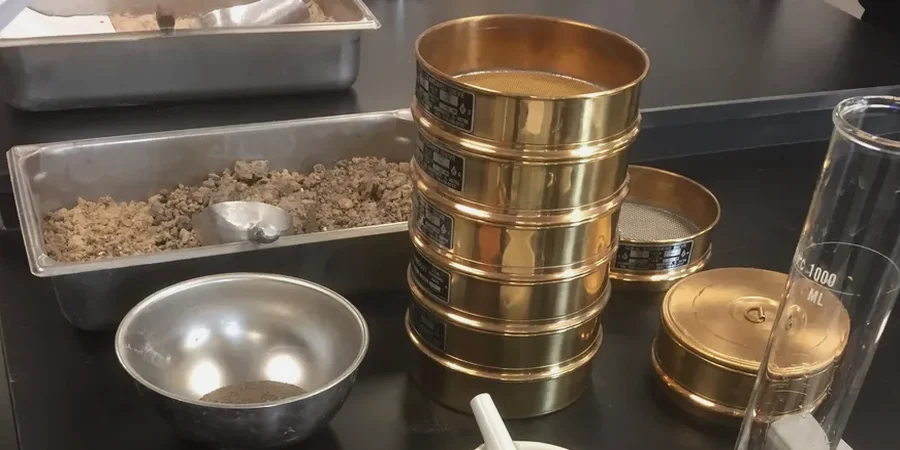
A stack of brass sieves on a Ro-Tap shaker, followed by a sedimentation cylinder in a constant-temperature bath—this is the daily rhythm of our particle-size lab. For projects in Ajax, where the glacial stratigraphy shifts from coarse outwash sands to silty-clay tills within a single borehole, running the full sieve-plus-hydrometer suite isn’t optional. It’s the only way to catch the fines fraction that controls frost susceptibility, drainage behavior, and compaction response. We process samples from test pits, SPT splits, and Shelby tubes, drying and washing them over the No. 200 sieve before the hydrometer run begins. When the gradation curve spans gravel to colloid-size clay, combining both methods gives you a defensible soil classification under the Unified system—and the engineering parameters that follow from it.
A sieve curve tells you what’s there; the hydrometer tells you what matters for water movement and frost action.
Process and scope
Local ground factors
Ajax grew fast through the post-war decades, and a lot of that expansion happened on agricultural land where the near-surface soils had been reworked by farming and drainage tile installation. We’ve pulled samples from older neighborhoods near Pickering Village where the upper two meters looked like clean sand in the field, but the hydrometer came back with 12 percent clay—enough to flip the USCS classification from SP to SP-SC. That matters for basement drainage design, for frost protection under shallow footings, and for infiltration trench sizing under OBC Part 8. If you skip the sedimentation analysis and design for a clean sand, you can end up with water ponding against foundation walls or subgrade softening during a wet spring. The grain size curve, when run correctly through both sieve and hydrometer stages, protects against those expensive surprises.
Reference standards
ASTM D422-63 (2007) – Particle-size analysis of soils (hydrometer), ASTM D6913/D6913M-17 – Particle-size distribution by sieving, ASTM D2487-17e1 – USCS classification, AASHTO T 88 – Particle size analysis (hydrometer), NBCC 2015 – Foundation and subgrade requirements
Other technical services
Full Spectrum Sieve Analysis
Mechanical shaking through a stacked sieve column from 75 mm to No. 200, including wash separation of fines and oven-dried mass balance.
Hydrometer Sedimentation Test
Type 152H hydrometer readings with temperature correction and meniscus adjustment, yielding the silt and clay distribution curve from 0.075 mm down to roughly 0.001 mm.
Dual-Method Gradation Report
Composite particle-size curve merging sieve and hydrometer data, with D10, D30, D60, Cu, Cc, and USCS/AASHTO classification.
Correlation with Atterberg Limits
When requested, we run the liquid and plastic limit on the same sample to cross-check the clay fraction and provide a full plasticity chart.
Typical parameters
Questions and answers
Why does Ajax’s glacial till need a hydrometer test instead of just a sieve analysis?
Halton Till and related deposits in Ajax often carry 20–40 percent fines, mostly rock flour and clay-sized particles. A sieve stack stops at the No. 200 opening (0.075 mm) and cannot distinguish silt from clay. The hydrometer sedimentation test quantifies the clay fraction, which controls the soil’s plasticity, permeability, and frost heave potential—all critical for Ontario’s climate.
What does a combined sieve and hydrometer grain size analysis cost for a project in Ajax?
A full combined analysis, including wash, mechanical sieving, and hydrometer sedimentation with the standard reading schedule, typically runs between CA$140 and CA$220 per sample, depending on whether Atterberg limits are included and the number of samples in the batch.
How long does the hydrometer portion of the test take from start to final reading?
The sedimentation test requires a minimum of 24 hours to capture the full range of particle sizes. After a 16-hour dispersion soak, we take readings at timed intervals from 0.5 minutes out to 1440 minutes. The complete report, combining sieve and hydrometer curves, is generally delivered within three to four working days.
Can you run grain size analysis on samples from test pits, or only from boreholes?
We process samples from any undisturbed or bagged source—test pits, SPT splits, Shelby tubes, or grab samples from open excavations. For Ajax sites with variable stratigraphy, we often recommend pairing grain size curves from test pit sampling with deeper borehole logs to get a continuous profile of the gradation changes with depth.